

// going bagless.

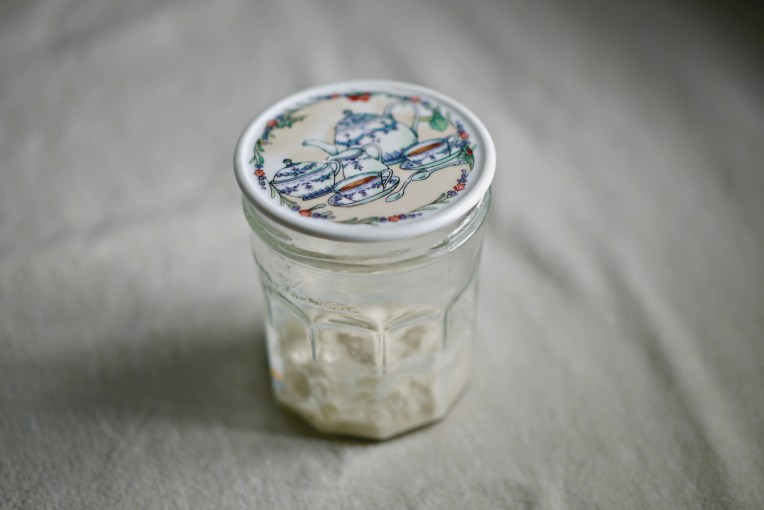
// losing a jar lid to rust, but found a substitute almost immediately.

// plastic-free baking measuring tools.

// upcycled cologne bottles.
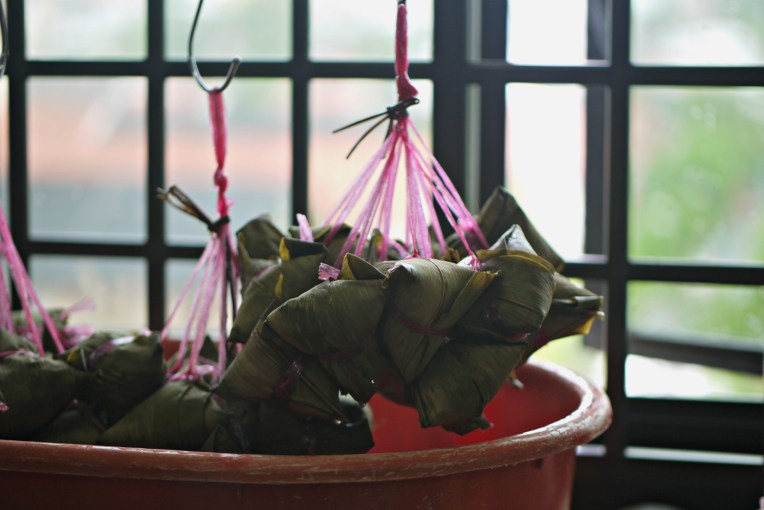
// we are ready.
// going bagless.
// losing a jar lid to rust, but found a substitute almost immediately.
// plastic-free baking measuring tools.
// upcycled cologne bottles.
// we are ready.
The mid-year school holiday will start this weekend and there is no lack of outdoor activities on our sunny island, a great opportunity for the little ones at home to get connected with nature or outdoor sports. I always fully embrace the idea of playing a local tourist at home as a frugal mom, so I have listed some events that have caught my eyes at the end of this post.
Let me first jump the topic to my homemade insect repellent as this is a must-have in my outdoor bag with the entire family being walking mozzie magnets. To start, let’s find a spray bottle.

Remember these handy mosquito repellents that the schools and RCs distributed a few years back? Check the expiry dates, they have probably passed their effective period. But don’t throw them away yet, the spray bottles can be refilled with a homemade Deet-free natural version, recipes and instructions can be easily found online like this, this, this and this.
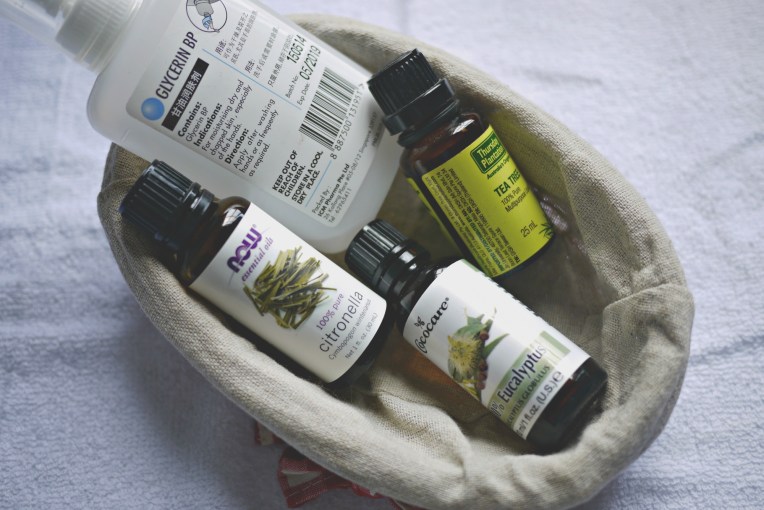
Most of these recipes require just 2 or 3 of the following ingredients.
An essential oil or mix that repels mosquitoes and bugs: choose from Citronella, Eucalyptus, Tea Tree, Lavender, Peppermint, and Neem just to name a few. My favorite combination is 70% citronella + 20% tea tree + 10% eucalyptus. If you are new to essential oils, stick to Citronella and try it out before getting more. Always, always dilute essential oils before use.
Some recipes use only witch hazel, some mix equal part of witch hazel to water. I choose the cheapest/convenient way, only boiled water that has cooled down.
// Vegetable glycerin as an emulsifier. I happen to have glycerin at home so I add it to my latest batch. For some reason, this works much better than just essential oil diluted with water.
// A carrier oil like sweet almond to bind the repellent better to our skin. I don’t usually a carrier oil, but an oil based repellent’s effectiveness will last longer without regular reapplication. When I need something stronger and don’t have time to reapply the water base repellent every hour, I will make a rub-on repellent instead by adding essential oil directly to the carrier oil and store this a brown bottle, away from light.
// Vodka is sometimes suggested to be added as a preservative. Since I don’t make the repellent spray in bulk, usually just enough for half a day outer activity, I don’t add it as well.
Now that the worry of getting bitten by bugs is out of the way, let’s run through to the outdoor activities for the coming school holiday:
+ Car Free Sunday on 28 May 2017. Wake up early and kick off the school holiday the car-free way!
+ Pesta Ubin 2017: Happening since May 10, but there are still plenty of free activities being organized every weekend.
+ Nparks Concert Series in the Park at Fort Canning on 3 June. It’s retro theme with music from the 60s to 90s this time.
+ DBS Marina Regatta from 1-4 June. Interesting activities such as trying out dragon boating and participating in various fitness sessions are available with pre-registration required.
+ SPH Gift of Music at Singapore Botanic Gardens on 10 June featuring Singapore Chinese Orchestra.
+ Kranji Farmer’s Market on 11 June. While you are there, take a self guided tour to explore the heritage trail that covers 14 historical and agricultural trail markers, such as Kranji War Memorial and Thow Kwang Industry that house the last dragon kiln in Singapore.
+ Gardener’s Day Out on 17 June at Hortpark.
+ Opera in the Park on 17 June at Singapore Botanic Gardens.
+ Weekends in the Park on 17 June at Pasir Ris Park.
+ Ecolife at Coney Island Park on 24 June , a guided tour with pre-registration required.
+ Istana Open House on Hari Raya Day 25 June.

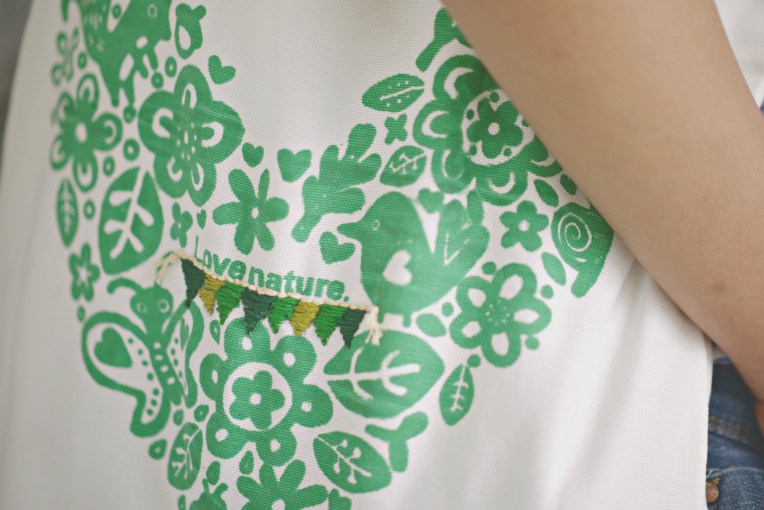
Being attractively simple in design, like a blank canvas, there is no lack of cotton tote bags with creative designs for sale in the market. In fact, cotton tote bags are also popular as corporate gifts and event goodie bags. So is it better for the environment with more people buying and switching to cotton bags? It depends. According to a study by UKEA, a cotton tote bag is more environmentally friendly than a plastic bag only if you use it more than 327 times, given that the carbon footprint emitted by the manufacturing process of a cotton tote is significantly higher than that of a plastic bag. This means that even if I use the cotton bags every weekend for shopping, that is still only 104 uses/days in a year. More than 3 years of uninterrupted weekend usage is required before the carbon footprint of the tote bag production can be offset and made comparable to a HDPE plastic bag. I am not sure if the cotton bags can last that long, but as this article readily pointed out, the ironical thing about cotton totes is that ‘people don’t actually use them.’
Besides having quite a few that I use regularly for grocery shoppings, I also try to use the well-made cotton tote bags stamped with corporate logos more often than they sit in the storeroom. This can be done by jazzing them up a little to look slightly less like a freebie and more like something from Etsy, with a few embroidery stitches here and some embellishments there.
Cotton tote bags function really well as a weekend carryall tote if you are blessed with a perfect size one like these below. Luckily, this makeover project is not too tedious given the subtlety of the corporate logo. I’m sure you can tell where the company logo used to be. And I managed to keep the rest of the original silkscreen motifs intact which I like very much. And off they go towards 327 days of usage, hopefully, more.




This post is inspired by a recent photo book I have read and re-read over the past week: HDB Homes of Singapore. 118 homes nestled in the heartlands are featured in this super thick (and 4.9kg-heavy) book by Japanese couple Tamae Iwasaki and Eitaro Ogawa. While I have always been awed by beautiful HDB apartments featured in the local decor magazines, this book isn’t about glamorous interiors or stunning home makeovers. Instead, the photographs bring these apartments to life by showcasing the real, surprisingly warm, and unedited state which homeowners live in, clutter and all. And it’s hard not to fall in love with these every day yet unique homes. Each featured unit and every photo come with a short narrative that the couple meticulously pens after talking to the homeowners to find out more about the stories behind themselves, their stage of life, their style, and even knick-knack items that filled and shaped the home.
I shall make an attempt to mimic this editorial style to feature a few easily-forgotten and underappreciated “spots” around my place that make it such a pleasure space to stay. Shamelessly labeling this home #119 : Simple Pleasures.
Thanks for making me fall in love and appreciate my HDB home all over again.

// No west sun means cooler rooms to enjoy in the evening.
// 没有夕照的房间, 夜晚家里的温度舒服一些.

// The homeowner appreciates this generous outdoor laundry drying rack design that seems to have disappeared in the newer flats. Solar power is free!
// 户外晾晒衣服的好处数不尽: 免费.环保.杀菌. 新一代的组屋快看不到了.

// Indoor greens, planted or drawn, are placed around the house for a soothing effect.
// 为空間或墙上增添一些绿意, 清爽过每天.

// The homeowner has a knack for diy decor items like this wool felt ball garland in the master bedroom. “Wake up happy” is a very possible blissful dream every day.
// 屋主偏爱手作品, 主人房墙上的羊毛球串是其中之一. “每天开心地起床” – 简单且实际的幸福梦想.

// Another handmade wool felt ball garland, this one is a colorful version placed in the kids’ bedroom.
// 又一手作羊毛球串, 彩色的, 让孩子的房间明亮起来!

// Souvenirs from holidays are meant to be displayed, not kept deep inside the cabinet.
// 把出国买回来的纪念品摆出来, 藏起来的别买.

// The family’s eco + diy habit has spread to upcycling glass jars, plastic cups and containers, and paper boxes into decorative or useful items around the house.
// 这家人把环保, 手作, 和居家良品合为一体了.

// A super practical way to use the window grilles. I spy a polar bear.
// 超级实际的窗口铁花. 看见北极熊在玩躲迷藏.
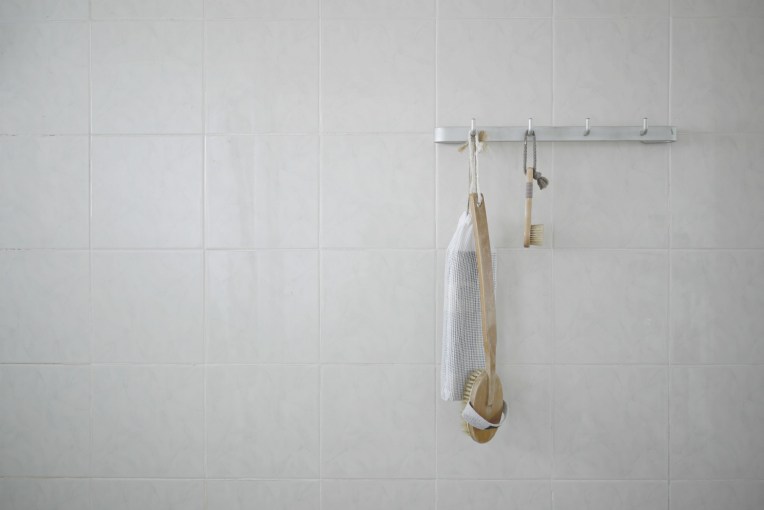
// A naturally bright and airy bathroom, keeping everything clean and fresh.
// 光线充足且空气流通的浴室, 自然就会清新整洁.

// Colorful spot in the bathroom, one of the pails used to be a bath tub for the children when they were newborns. Personal memorabilia! Can you guess which one?
// 多彩的浴室角落, 其中一个塑胶桶是屋主的小孩刚出世时用过的婴儿浴盆. 小朋友的个人纪念品! 猜得到是哪一个吗?

// Waste paper and newspaper recycling spot, neatly stacked up and bundled with paper strings.
// 整齐的纸张环保角落, 的确会让人更愿意分类,整理.

// Another colorful spot, the household waste sorting and recycling corner. The homeowner revealed that she is gathering a set of sandcastle building tools by upcycling various plastic containers collected over the past few weeks. She has so many different eco projects ideas!
// 又一个多彩的环保角落, 小小的垃圾分类回收区. 屋主透露这几个礼拜正在累积无法避免的塑胶包装材料, 把它们循环成堆沙城堡工具,模具. 全年都有不同的环保创意主題!
HDB Homes of Singapore is available at here and an exhibition titled HDB Homes Of Singapore: The Photo Exhibition by Keyakismos and Tomohisa Miyauchi is currently held at SPRMRKT till 27th June 2017.
Save

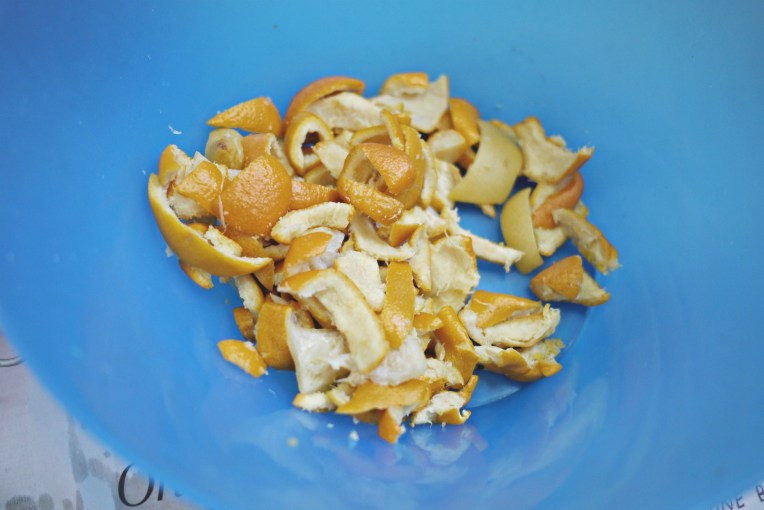
I started making Eco enzyme during Chinese New Year when I cumulated quite a lot of mandarin orange peels. Eco enzyme is a mixture of 3 ingredients: fresh fruit or vegetable scraps, sugar, and water that goes through 3 months of fermentation and then turns into a vinegar based eco detergent that has many uses around the household. While finding out how Eco Enzyme works, I read that the term eco enzyme is more of a “colloquial term” than a real enzyme product.
The real enzyme is probably what Tampines estate is using to kill their cockroaches when they recently announced that they will be going the enzyme route as a more effective form of pest control treatment, after a month-long trial last year showed positive results. I had to admit that I cringed a little when I saw the reporter licking off the enzyme solution from her finger to show that it is edible and completely safe. Then again, how I wish that everything we wash down our drain should be as safe as this. I always thought that for a population that counts a small part of our drinking water from reclaimed sewage water, we should be more wary of the chemicals that we wash down our drains. But of course, the water treatment technology is more sophisticated and advanced that I think. Still, I prefer less harsh chemical detergents around the house, and even better, make one on our own with ingredients that we know are safe.
The Eco enzyme I made is not for consumption purpose. And there are only 3 steps. The initial time spent on mixing the ingredients takes less than 5 minutes, then we leave the rest to Science to break down the scraps and turn it into an environmentally friendly household cleaning solution. Here’s how:
Step 1 : Gather a plastic container with a lid, fresh vegetable and fruit scraps, black or brown jaggery sugar, and water.
Step 2 : Fill up the container with 10 parts water, stir and dilute 1 part sugar, then top with 3 parts of fruit peels and vegetable scraps and stir again to mix well. Leave enough gap in the covered container for air to expand during the fermentation process. Cover the container, keep it slightly loose, not screwed too tightly and leave this in a cool area away from the sun for 3 months.
Step 3 : Filter to extract liquid enzyme. I use a coffee filter bag with wire handle for this job. Store the Eco enzyme in plastic bottles and dilute according to usage. The residue that has been filtered out are useful as plant fertilizer.
After reading up, making and applying the Eco enzyme in household cleaning, following are some tips and links that I have penned down/bookmarked during my DIY Eco enzyme journey and hope that you will find it useful as well.
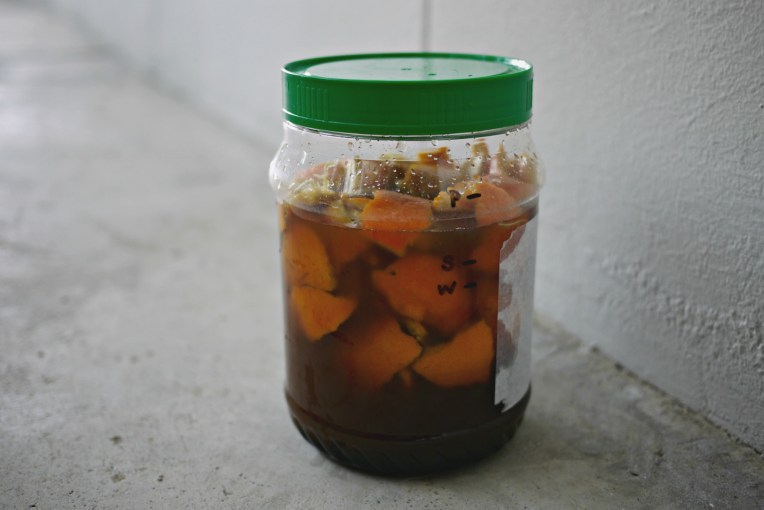
Gas will build up during the fermentation process might cause a glass container to explode. Even though plastic ones are safer, always leave a gap inside the container when filling up the ingredients. Also, for the first month, open the cover to let build up gas escape every day when fermentation is most active. On certain days, I can even hear a fizzing sound of air escaping as I unscrew to open the lid. After 1 month, check on the eco enzyme once a month. Stir the solution to keep everything well mixed once a while.
Citrus based fruit peels make the best smelling eco enzyme. For my first batch, I added 100% mandarin orange peels. Later I learned that one of the benefits of making Eco enzyme is to reduce the amount of kitchen waste sent to landfills. Since scraps like vegetable roots, peels, yellowish leaves are unavoidable, turning them into Eco enzyme instead of throwing them away is a great way to reuse them. I have since been following a 70% fruit to 30% vegetable scrap ratio to keep my final Eco enzyme smelling good and to do my part to ease the landfill load. However, only fresh scraps can be used. Do not include cooked leftover vegetable scraps that are uneaten.
That is a method I learned from a DIY workshop ran by this group mentioned in this article to measure the ingredients required for a batch of Eco enzyme without a weighing scale.

Firstly, cut out a strip of thin paper as long as the height of your container without the lid, I always use the newspaper since it is thin enough for me to do multiple folds.

Next, fold it into halves 4 times, so that when you unfold the paper, you get 16 equal parts.

Mark the paper according to the recipe, with 10 parts for water, 1 part for sugar and 3 parts for fruit/vegetable scraps, leaving the remaining 2 parts for an air gap.

Trace the marks onto the bottle.
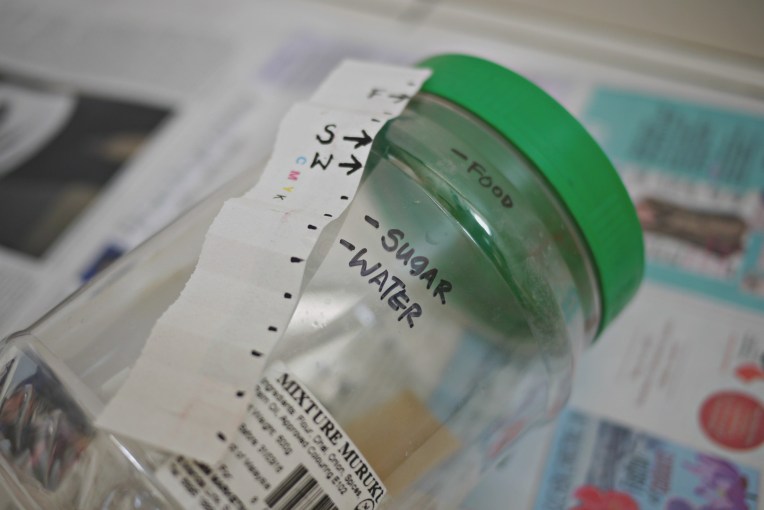

Then I add the ingredients in this order: 1. pour water till it reaches the marked “water” level, 2. add sugar until it displaces the water to reach the level marked “sugar”, and finally 3. drop fruit peels and vegetable scraps till the liquid level reaches “food”. Give it a good mix and cover.
It should be brownish with a pleasant citrus vinegar aroma. Filter with a cloth bag to retrieve just the liquid portion and store the Eco enzyme in plastic bottles.


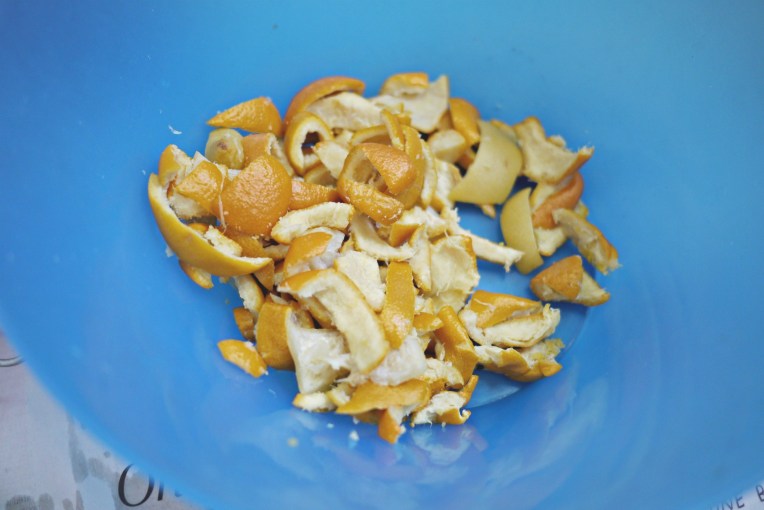

I have just harvested my initial batch that yields fewer than 2 litres, too precious to be used nonchalantly. I am currently using it to mop the floor, cleaning the kitchen counter and as fertilizer for my plants. This is a list of household uses and dilution instructions for Eco enzyme which I find will come in handy when my next few containers reach their 3-month fermentation target.

Anyone with experience to chip in more? I find myself barely scratching the surface. I am lucky that my first few containers fermented without a hitch. Nothing rot. No terrible smells. Will update as I go along if there is anything worth a mention, both making and using it.
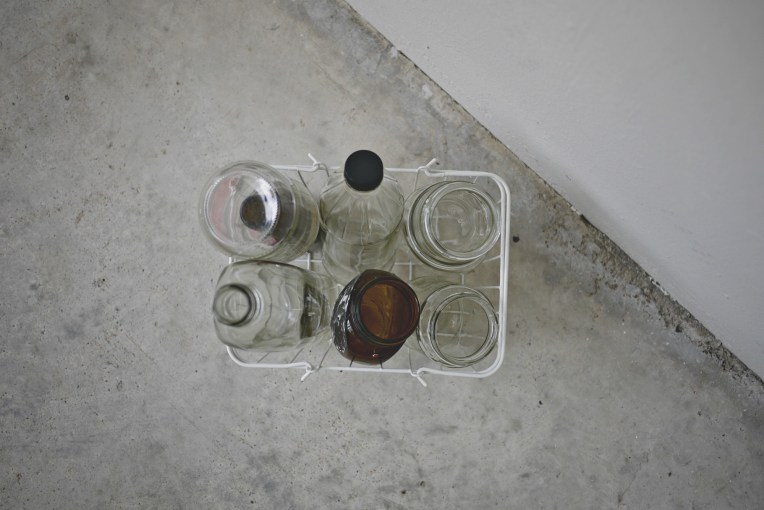
// My reusable glass jars and bottles, all clean and shiny.

// A matching pair for storing evaporated milk and condensed milk.

// A perfect fit, albeit after chomping 4 biscuits from a new pack. Because I don’t want something that takes up more pantry space than the pack of biscuits needs.
// harvesting my first batch of eco enzyme.

// because mending makes clothing last longer, so I am teaching my kids how to sew a few simple stitches.

I visit the supermarket mainly for chilled/frozen items, stuff that I cannot get from the wet market. Last Monday, I experimented with shopping a day’s worth of meatless grocery at the supermarket to get food items with as little packaging waste as possible. Armed a few small cotton produce bags (road test!) and just ONE reusable shopping bag – a method I adopt very often to avoid over-purchase/impulse purchase, I headed to the nearest supermarket that carries a wide range of fresh produce and here are the items + packaging waste I bought.
Nowadays, almost every type leafy vegetable is bagged in crisp clear plastic bags for a more convenient checkout process. When it comes to vegetables like brinjals, gourds, cabbages, peas, lady fingers, asparagus, and taro, I found them individually wrapped with plastic cling film at some supermarkets. Some items like chilies and long beans even come with an additional styrofoam tray.
The stall holders at the wet market bag some of the vegetables after weighing so I can tell the “cashiers” in advance that I do not require their plastic bags, and offer 1) my cotton bags or 2) request to wrap them in newspapers instead. I usually avoid getting those that are already bagged, or I visit the market really early to “catch” these vegetables before they are being packaged. And cabbages, cauliflowers, and radish are never shrink-wrapped at the wet markets. I could thus avoid most of the plastic packaging waste when I shop there.
There is only one aisle with open crates of broccoli, carrots, tomatoes and capsicums (yes, only these 4) greeting me warmly with their bright colors sans any plastic packaging, so I bought all four varieties.
Packaging waste count: As these vegetables are sold by weight, I ended up still having their price labels (and receipt) as trash.

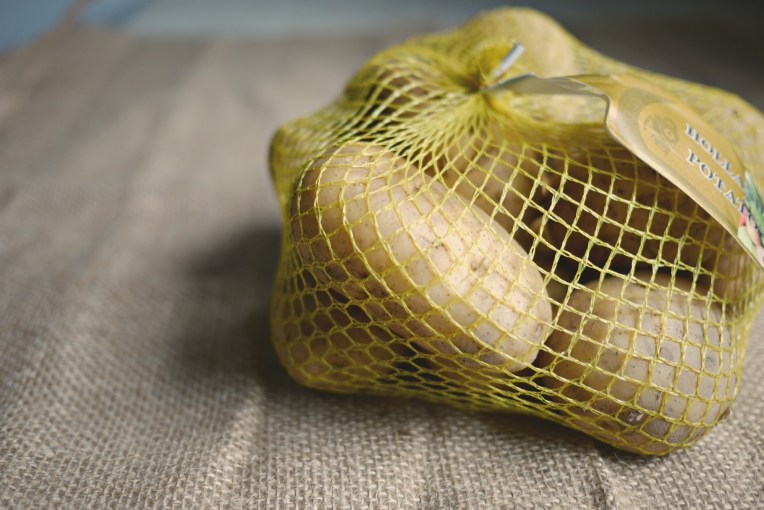
Only Holland potatoes and Russet potatoes come in these mesh bags that I like to reuse. The rest are packaged in plastic bags. So I got the Holland potatoes. At the wet market, I usually buy about 5 each trip as they are sold in bulk. I hope I can finish these up before they start to sprout and shrivel and end up as food waste.
Packaging waste count: The mesh bag can be reused, this becomes handy when buying root vegetables or shiitake mushrooms at the wet market so that the stall owner doesn’t have deduct the weight of my self-brought container since these bags are very light. The plastic item tag was unfortunately trashed.
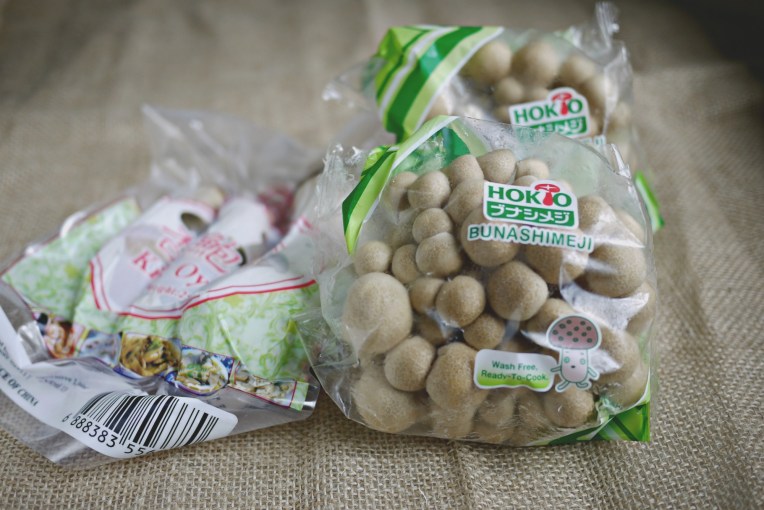
Other than fresh shiitake mushrooms that I buy and store in my reusable covered containers, I almost can’t find other types of mushroom that do not come with plastic packaging. I say almost, because I have seen brown and white button mushrooms sold in bulk occasionally. Since I usually get pre-packed Erynjii and Shimeji mushrooms from the wet market as well, I stick to these varieties instead of shiitake that are packed in plastic bags at the supermarket.
Packaging waste count: plastic bags, same outcome if I were to shop at the wet markets.
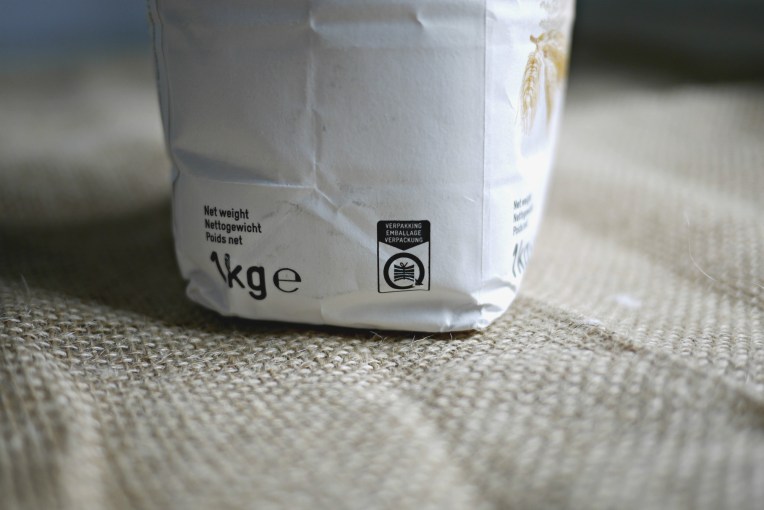
I get white flour sold in bulk at the dried goods store. While the supermarket does not carry flour in bulk, I found this brand packed in a paper bag that can be recycled.
Packaging waste count: None.

Since I buy pasta from supermarket all the time, I went straight for the one that is packaged in a paper box.
Packaging waste count: a small plastic sheet that made up a see-through window on the cover of the box.

Processed foods come with plenty of packaging trash. With home cooked meals 80% of the time in my family, I will be lying if I say I don’t use any kind of processed food to help in my cooking. Condiments, ready-made sauces, and vegetarian’s favorites such as seaweed sheets, kelp, fried bean stick, tempeh, and fried tau pok, ingredients I use all the time come with some form of plastic packaging. Not to mention common items like sugar and salt also come in plastic bags.
To counter the build up of non-recyclable processed food packaging waste at home, I stick to the obvious solution of buying these in recyclable tin cans or glass bottles as far as possible. If not, indulge in processed foods as infrequently as possible, which makes a healthier option as well.
Packaging waste count: flexible food foil packaging
In case you are curious what I cooked for that day with the items bought:

Lunch: Baked pasta
~ penne, broccoli, red capsicum, shimeji mushrooms, cooked with garlic, butter, cheddar cheese, whipping cream available at home.

Honey Bread loaf.
~ White flour, baked with wholemeal flour, honey, steamed taro, instant yeast, salt and butter available at home.

Dinner dish #1: broccoli, red capsicum, shimeji mushrooms, stirfried with ginger slices and vegetarian oyster sauce available at home.

Dinner dish #2: Tomato omelette with eggs available at home.

Dinner dish #3 : Instant vegetarian rendang with potatoes, added tau pok available at home.

Instead of Tenugui, I hand sewn another version of produce bag with another 100% cotton fabric found under the curtain section of Daiso. Like the scallop border, so I sew the bag without drawstring loop to keep this design intact and simply seal the sides using the blanket stitch.

Reinforce the bag opening by going through the fabric with several repeated stitches using contrasting colored thread.

And they turned out nicer than I thought.

My hand sewn drawstring bag turned out more useful than I thought. Originally made to store my homemade bread, I have started using them for buying loose items like dried beans and mushrooms from the dry goods store. I have also started using them for the fresh produce shop, for broccoli, cauliflower, tomatoes, carrots, fresh mushrooms….
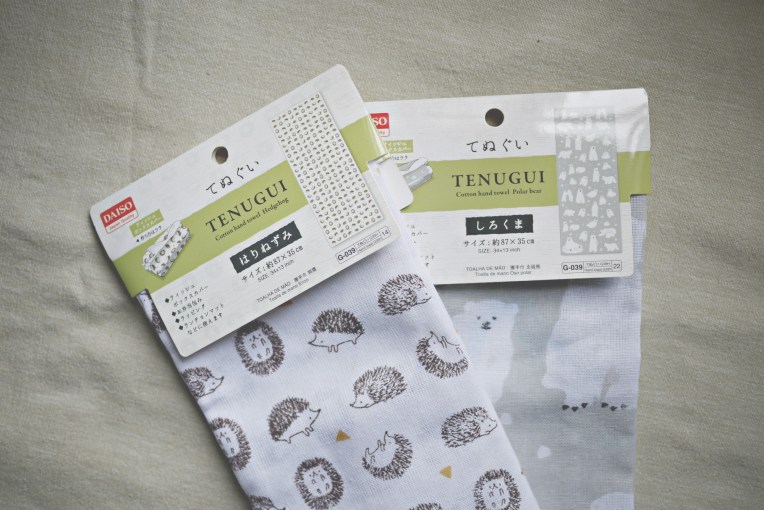
I used this Tenugui from Daiso, measuring 87cm x 35cm. Since they already come hemmed at the sides, sewing work is minimal. I chose to sew a drawstring version so that the produce will not fall out from the bag. An alternative is bag clip, this will be an even simpler project as there will be no need to sew a loop for the cord.
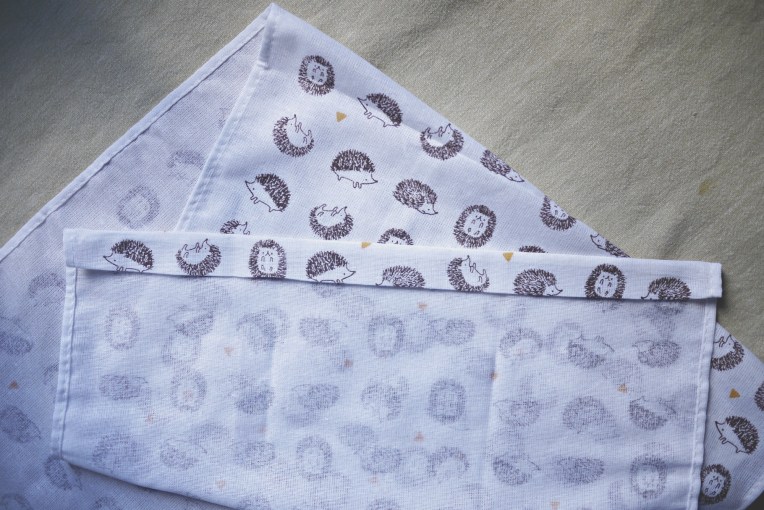
Fold and iron the shorter sides to create a loop for the string to go through later.
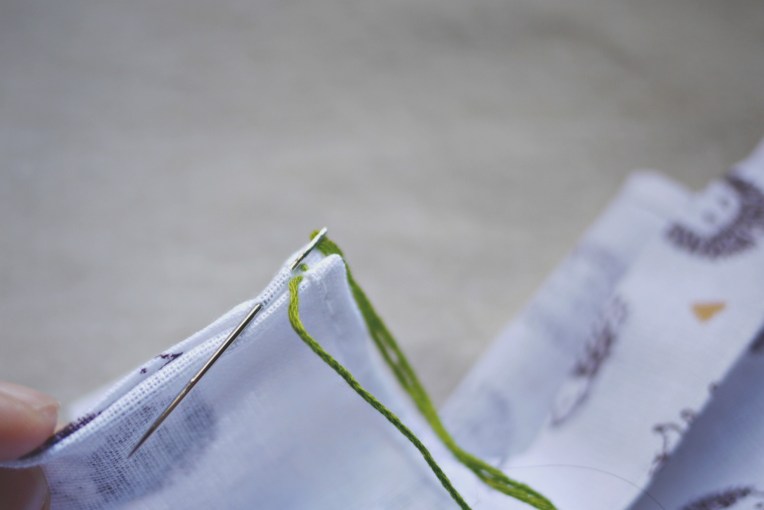
Start sewing. I sew with a blind/invisible stitch so that the stitches can hardly be seen on the right side of the fabric.


Here is a great instructional video to illustrate the how-to.

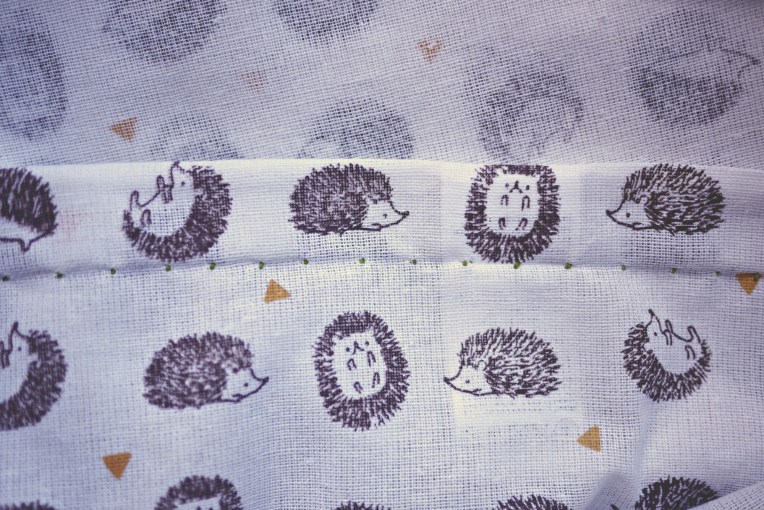
If I use white color thread, the stitches will hardly be noticed. Repeat the series of blind stitch on the other end.

To sew the side seam, I used the blanket stitch. And here’s another video.
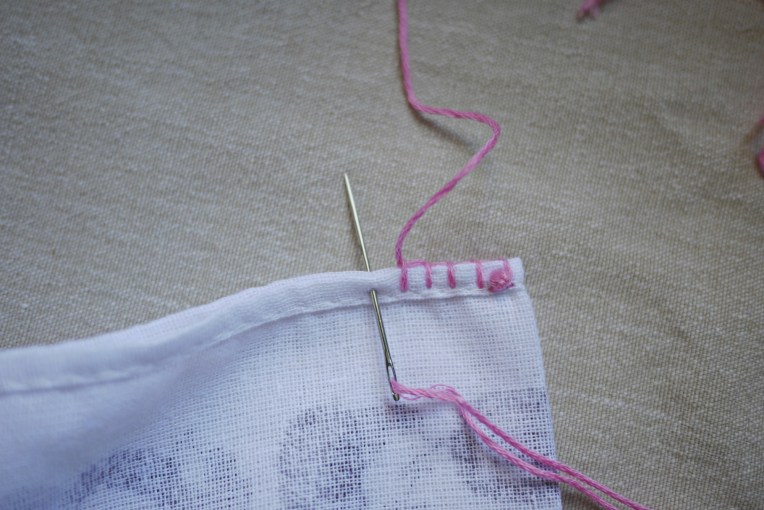


Stop sewing when you reach the loop section.
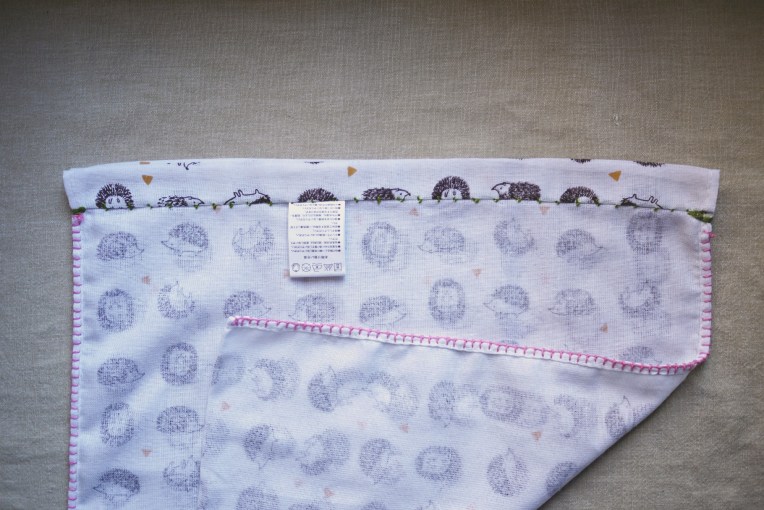
Repeat for the other side.

Flip the bag out.

I used a safety pin to guide a cotton ribbon through the loop.

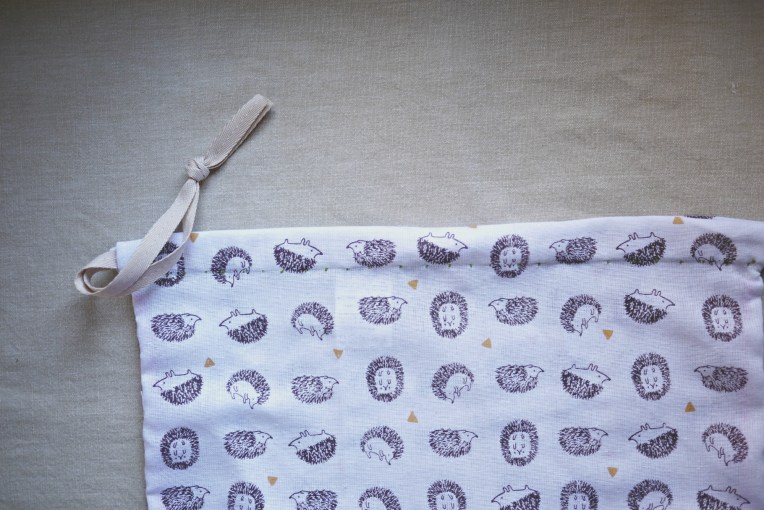
Tie a knot with the ends and the cotton drawstring bag is done. Handwash and line dry before use.
 MONO and CO