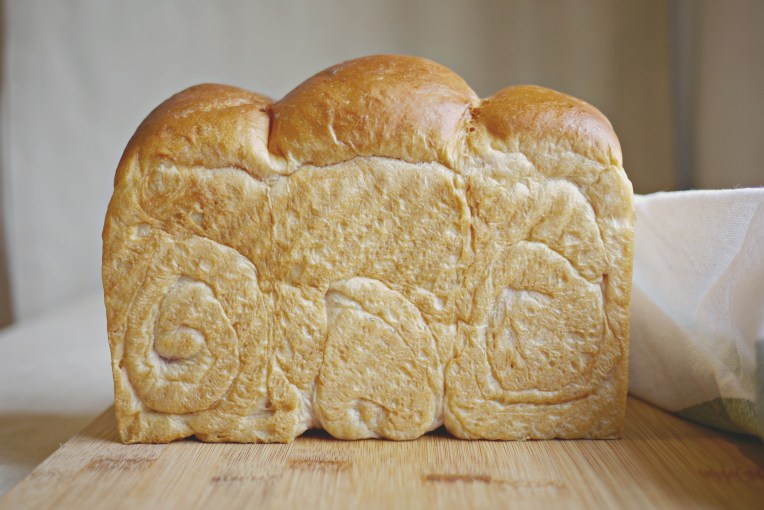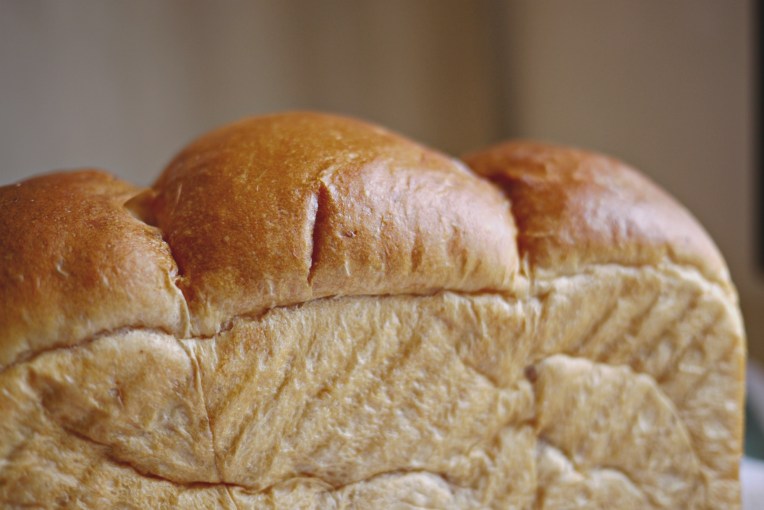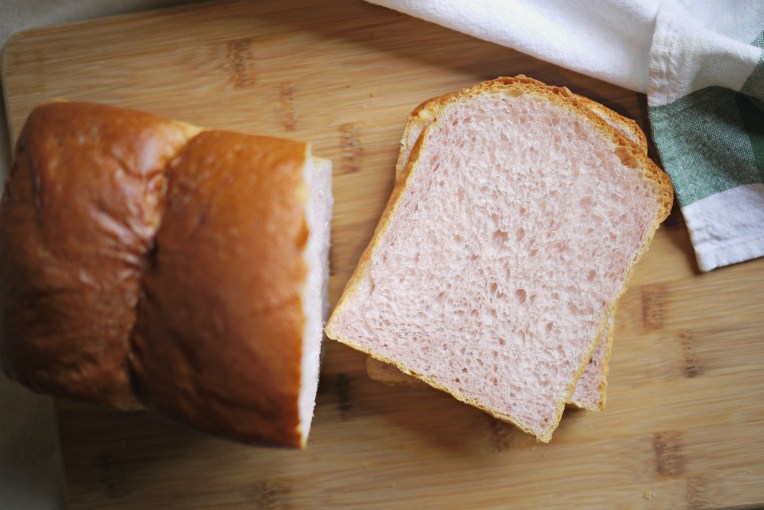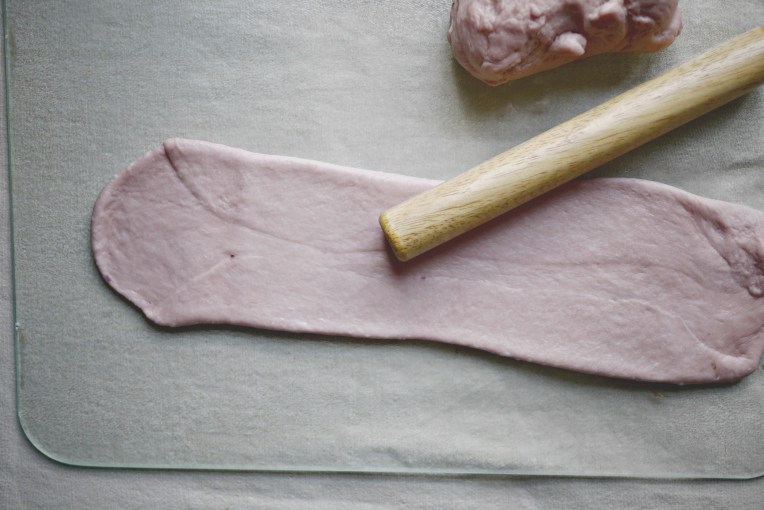
Fluffy Soft Taro Buns

Fluffy Taro Buns // Mono+Co Fluffy Taro Buns // Mono+Co Fluffy Taro Buns // Mono+Co Fluffy Taro Buns // Mono+Co

I am still a novice when it comes to fancy bread shaping.  But I am learning.

Most of the time, I decide the shape of my bread while the dough is going through its bulk rise, not before I start gathering ingredients to bake.  Having said that, there were occasions when I switched lanes at the very last minute.  It helps that bread recipes are really versatile in terms of shaping and baking.  Like today’s post.  The bread was meant to be baked into a loaf, I changed pans to bake them into small buns instead.  On a separate day, I might shape them into bagels and bake them on a tray.  Or, divide the dough into 3 portions, and bake a plaited loaf.  The possibilities are endless, as long as the recipe produces soft buns that I like.

The basic ingredients and method that I have been playing around with are pretty similar.  To the purists, bread should be no more than a coagulation of flour, water, and yeast.  I added more because I will be bored with eating the same thing every day.  Same reason for shaping them differently.  With a little bit of prompting from my grocer (taro was highly recommended that day!) and some creativity in shaping the bread, I can’t wait to explore more on bread shaping.


Fluffy Soft Taro Buns

230g bread flour
1/2 tablespoon instant dry yeast
1/4 teaspoon sea salt
2 tablespoon raw sugar
100g steamed taro
1 large egg **
30-40g water
37g cold butter
optional toppings: black,white sesame seeds

** I use a large egg weighing 70g

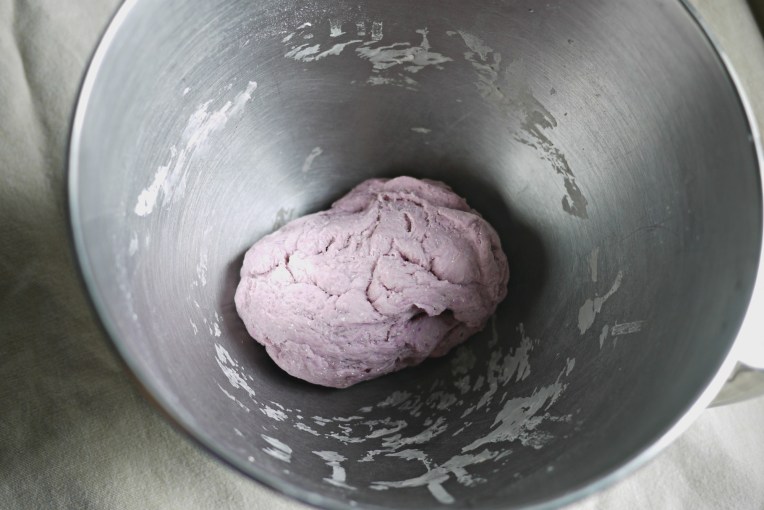
In mixer bowl, combine bread flour, yeast, salt, and sugar well with a hand whisk.  After the dry ingredients are mixed, add cooled mashed taro, beaten egg and half of the water.  Start the mixer and knead on its lowest speed (KA 1) .  If the ingredients do not come together into a ball, slowly add more water, tablespoon by tablespoon, once a rough ball dough starts to form, stop. Let the dough sit for 15 minutes.  If your kitchen is windy, cover the bowl with a clean tea towel.

After 15 minutes, start the mixer again and knead for 1 minute before adding cubed butter, one by one.  Knead this until the dough reaches window pane stage; when the dough becomes very smooth and elastic.  Remove bowl from mixer and bulk rise this for 1 hour.  It will rise to double its original volume.

Punch the dough down and transfer it to a clean work top.  Divide the dough into 6 equal portions and shape each one of them roughly into a ball, let them rest for 15 minutes, covered.

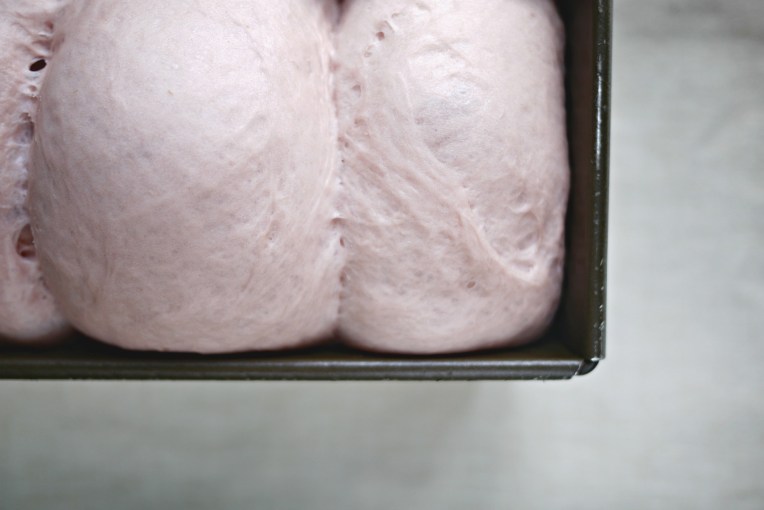
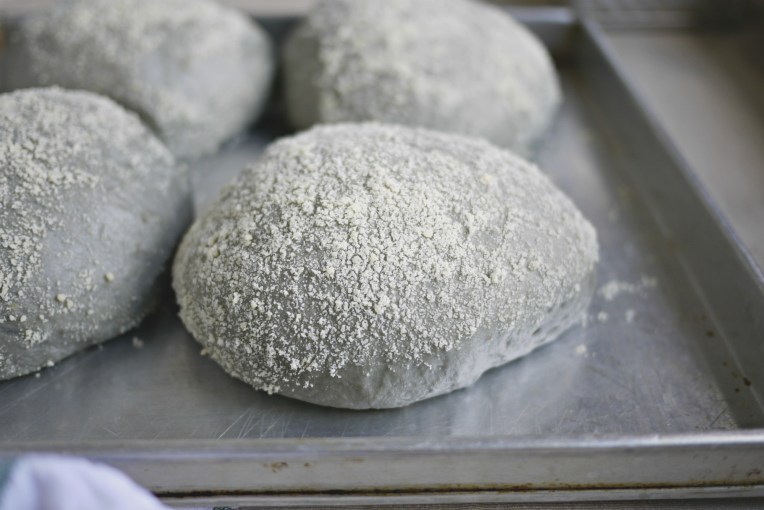
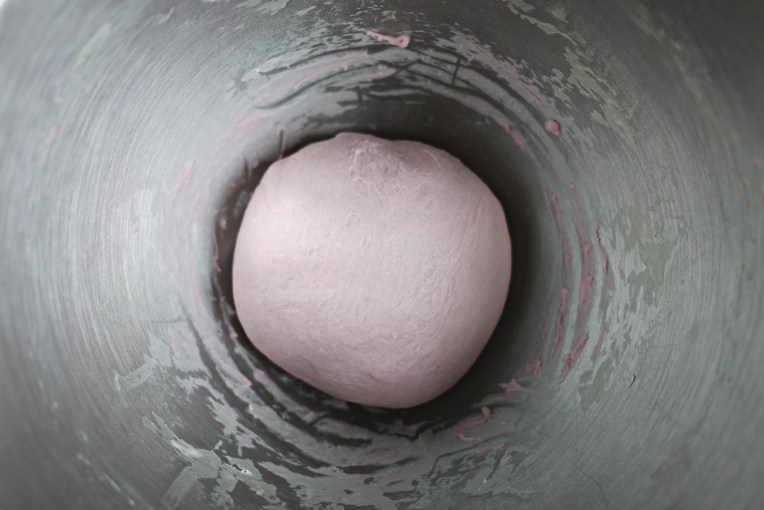
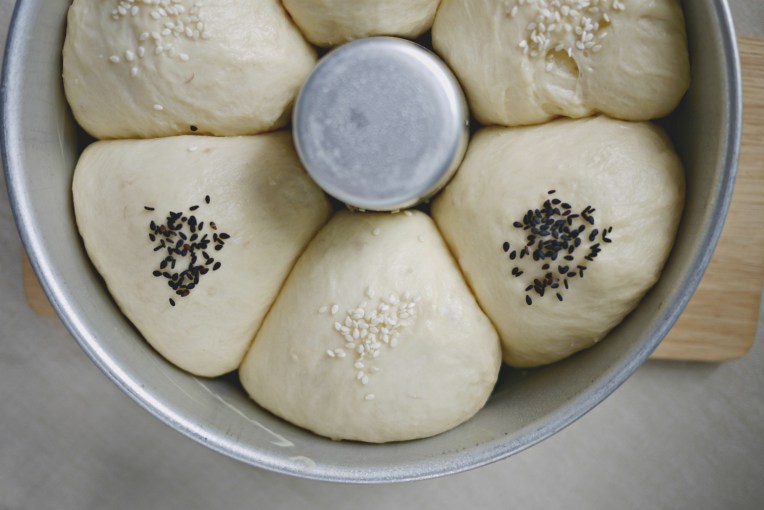
After 15 minutes, the doughs would expand slightly.  With a rolling pin, flatten each dough to push out the gas and then shape them into tight balls.  Place them in a well greased 8″ tube pan and proof for 50-60 minutes.  The doughs would expand to reach the top of the pan, and form triangular shaped buns.  Spray a light mist of water on top, and sprinkle black/white sesame seeds on each dough.

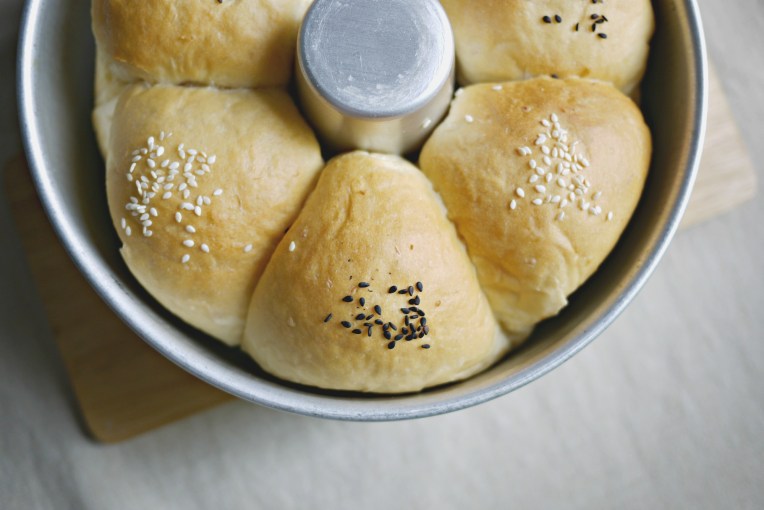
Bake in a preheated oven at 160C for 25 minutes.  Once done, invert pan to carefully remove bread from the pan and let it cool completely on a rack.

Save

Save

Save

Save

Save

Save

Save

Save

Save

Save

Purple Sweet Potato Bread Loaf #3

Soft Purple Sweet Potato Bread Loaf // Mono+CoSoft Purple Sweet Potato Bread Loaf // Mono+Co

To answer my own question from here, yes, sugar made a different in height.  I also added one egg instead of half to save the trouble of finding another recipe to use the remaining egg.  So maybe it helped too?

Nothing else is new here, so I simply copy and paste the recipe from loaf #2 post, and added a series of photos to demonstrate how I shape the loaf.  Hope this helps.

Soft Purple Sweet Potato Bread Loaf // Mono+CoSoft Purple Sweet Potato Bread Loaf // Mono+CoSoft Purple Sweet Potato Bread Loaf // Mono+CoSoft Purple Sweet Potato Bread Loaf // Mono+Co Soft Purple Sweet Potato Bread Loaf // Mono+Co    Soft Purple Sweet Potato Bread Loaf // Mono+Co


Purple Sweet Potato Bread Loaf

220g bread flour
1/2 tablespoon instant dry yeast
1/4 sea salt
2 tablespoon raw sugar
100g purple sweet potato, steamed + mashed
1 large egg **
40g water
40g cold unsalted butter, cubed

** refers to large egg that weighs at least 70g including the shell.

Combine flour, yeast, sugar and salt in a mixer bowl and stir with a hand whisk to mix these dry ingredients well.  Add sweet potatoes, beaten egg and water, turn the mixer on lowest speed (KA1) with a dough hook, and knead until the ingredients come into a ball.  Stop the mixer and let this dough stand for 15 minutes to allow liquid to be absorbed better by the flour, I find that kneading to reach window pane stage later will be easier with this additional dough resting step.

After 15 minutes, turn the mixer on again to knead the dough for 1 minute, then slowly add cubed butter one by one, and knead till dough reaches window pane stage.  Remove bowl from mixer, and let it proof for 60 minutes, covered and placed in a draft free place.

The dough would have expanded to twice its size.  To test if it is ready to be shaped, poke a hole in the center with a floured finger, the dent should not bounce back if the bulk rise is completed.  Once the dough is ready, punch down the dough to deflate it, and transfer it to a clean work top.

Soft Purple Sweet Potato Bread Loaf // Mono+Co

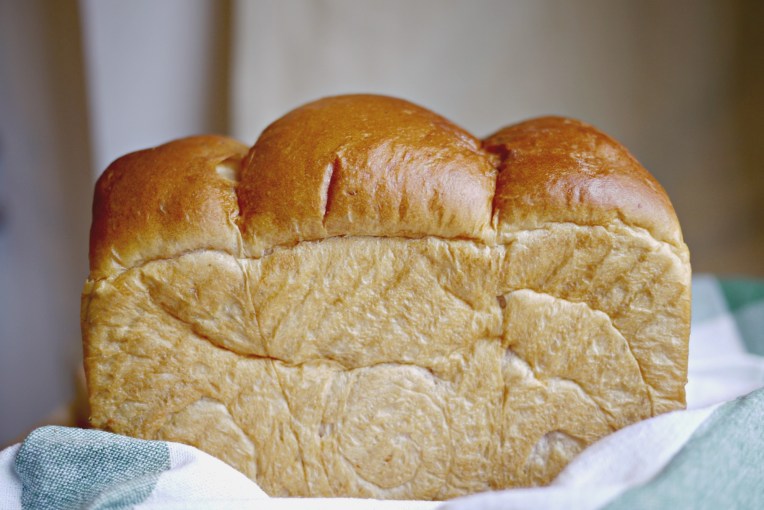
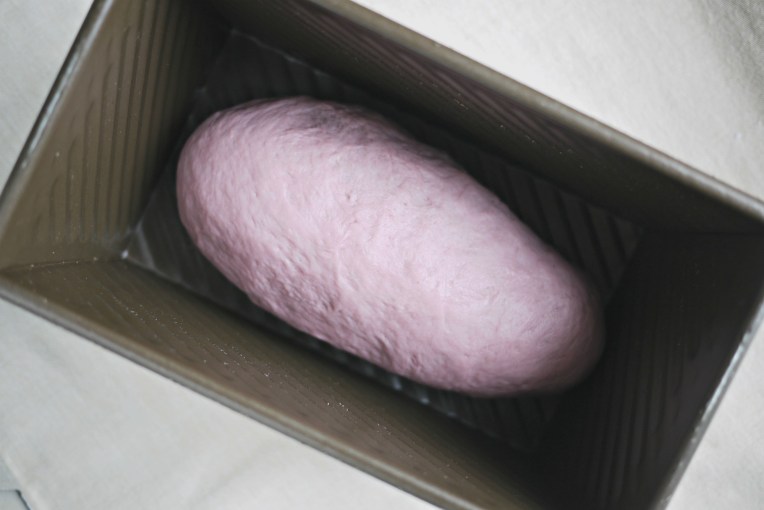
With a rolling pin, flatten the dough to push out gas trapped inside the dough.  Divide the dough into 3 equal portions.  Shape each ball as follow and place them in a bread tin, seam side downwards, and proof for another 60 minutes.

Soft Purple Sweet Potato Bread Loaf // Mono+Co Soft Purple Sweet Potato Bread Loaf // Mono+Co Soft Purple Sweet Potato Bread Loaf // Mono+Co Soft Purple Sweet Potato Bread Loaf // Mono+Co  Soft Purple Sweet Potato Bread Loaf // Mono+CoSoft Purple Sweet Potato Bread Loaf // Mono+Co

Bake in a preheated oven at 170C for 30 minutes.  When done, remove bread from tin immediately and let it cool completely on a rack before slicing.

If you like your bread loaf soft at the top, brush over the top crust with butter when the bread is freshly hot out of the oven.  The soft dome top also makes slicing easier after the bread has cooled down.

Soft Purple Sweet Potato Bread Loaf // Mono+Co

Save

Save

Save

Save

Save

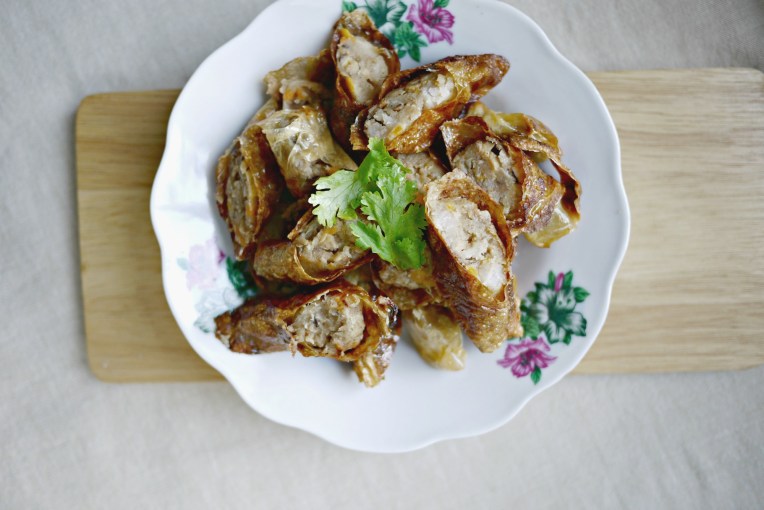
Meatless Ngoh Hiang Yam Rolls

2016-10-10-003tossednoodles_nhorhiang

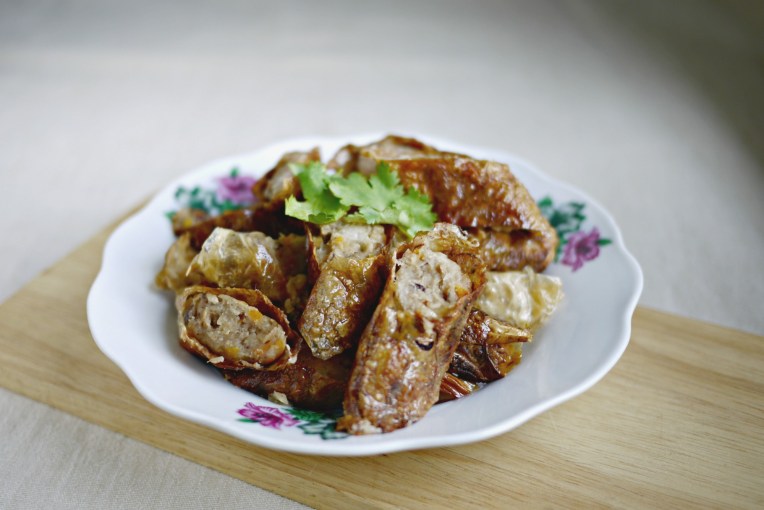
One of my kids’ favorite dish is their granny’s Ngoh Hiang or Lor Bak, which seems similar to sausage, with minced pork and prawns rolled up in dried bean curd sheet, steamed then deep fried to golden brown.  The vegetarian food stalls offer a vegetarian version with mock meat and mashed taro/ yam, and smells just as delicious as the meat version due to a common seasoning ingredient : 5-spice powder.

My first attempt ended up with a yam roll that has somewhat a softer center than the commercial version as the ingredients are held together with only mashed yam, that doesn’t really firm up with cooking.  I will try my next vegetarian Ngoh Hiang with added flour that will help the rolls to firm up after steaming.  But I will most likely go back to the version without fillers, even after affirming that adding flour helps to make a firmer roll that is easier to slice and serve.  After all, home cooking is all about making wholesome food with real ingredients, never mind if the food ends up looking uglier, I always have patterned plates and edible garnishes to come to the rescue!


Meatless Ngoh Hiang

120g taro yam, steamed and mashed
3 dried chinese mushrooms, softened and finely chopped
1/2 small carrot, finely chopped
1/2 tablespoon 5-spice powder
1 tablespoon vegetarian oyster sauce
a dash white pepper
1 tablespoon oil, for cooking fillings
3 tablespoon oil for pan frying the rolls
1 sheet dried bean curd sheet**

** I used only 1/4 of a packet of the dried bean curd sheet with my small serving recipe that makes 3 x 30cm rolls. Cut out the size you need, or increase ingredients proportionately to use it up.  Always remember to wipe gently but thoroughly the surface with a clean damp cloth to remove a layer of salt that is used to preserve the bean curd sheet.

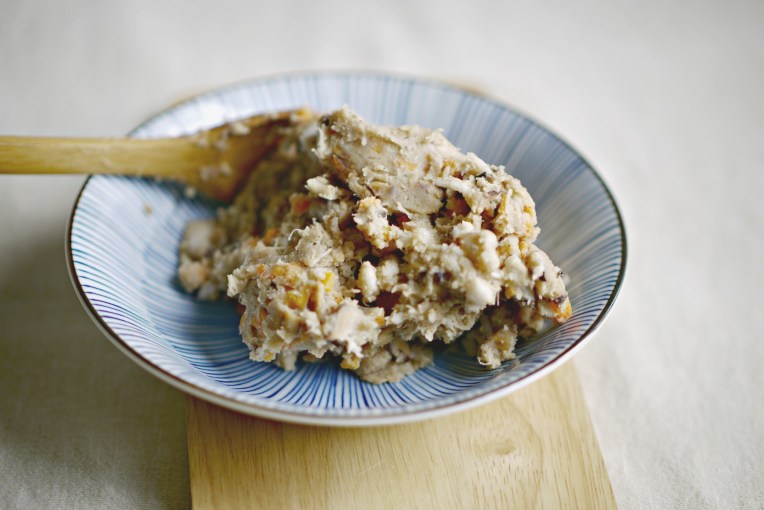
Start with a clean hand or wooden spoon, mix mashed yam, chopped mushrooms, carrots, with 5-spice powder, vegetarian oyster sauce, and white pepper to a uniform mixture.

2016-10-10-005tossednoodles_nhorhiang

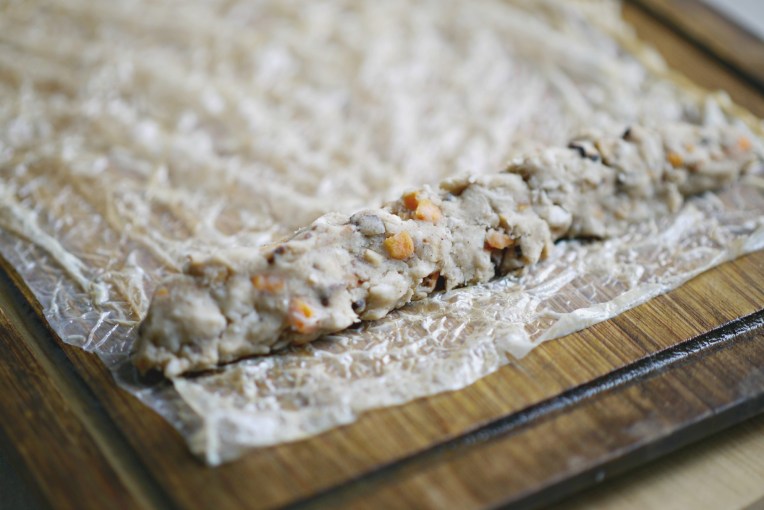
Scoop out 1/3 of the fillings, and spread it on the bean curd sheet that has been wiped over with a clean damp cloth.   Roll it up swiss roll style for about 2 rounds, slice off the remaining beancurd sheet, and place the roll on a plate, seam side downwards.

2016-10-10-006tossednoodles_nhorhiang

Repeat till you get 3 rolls.

2016-10-10-007tossednoodles_nhorhiang

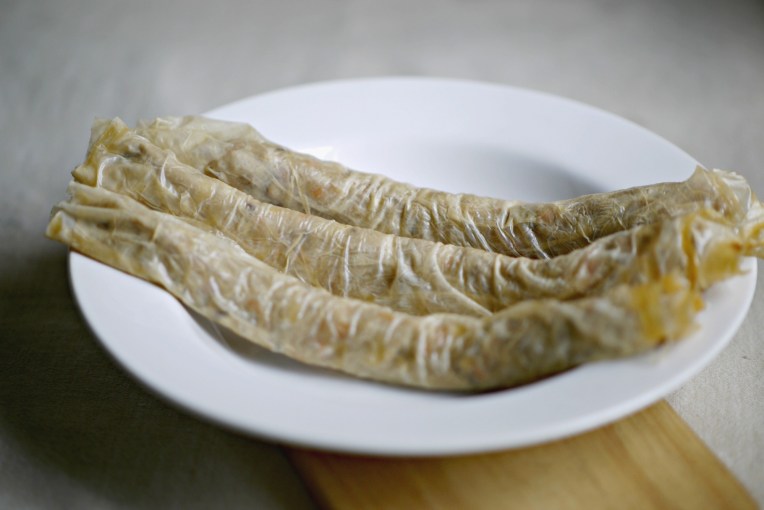
Place them in a steamer and cook for 10 minutes.

2016-10-10-008tossednoodles_nhorhiang

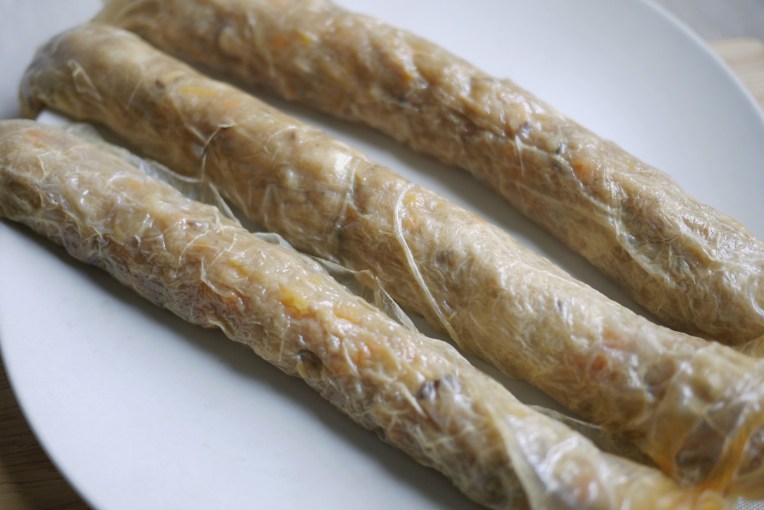
After steaming, the rolls becomes more translucent.  Let them cool completely before pan frying them in a skillet with 2 tablespoons of oil, seam side down first till the skin turns crispy and golden brown.

2016-10-10-009tossednoodles_nhorhiang

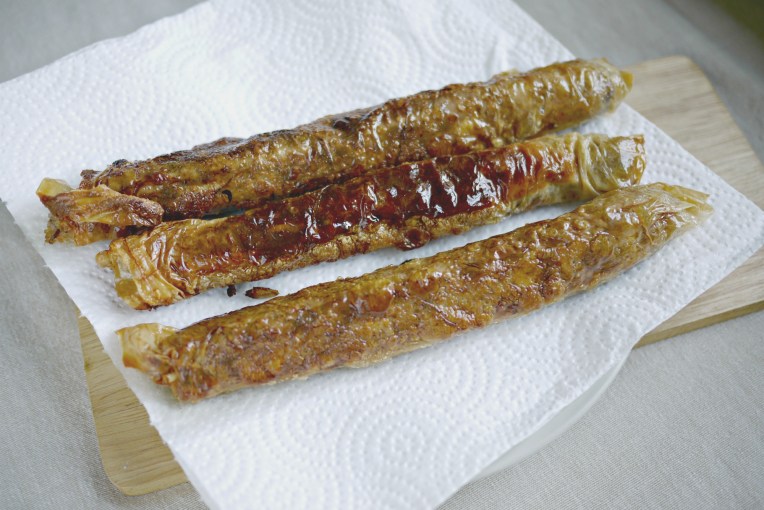
Place fried yam rolls on a layer of kitchen towel to absorb excess oil.  Then slice the rolls with a very sharp knife (I used a bread knife) and serve immediately.

2016-10-10-010tossednoodles_nhorhiang

Save

Save

Save

Save

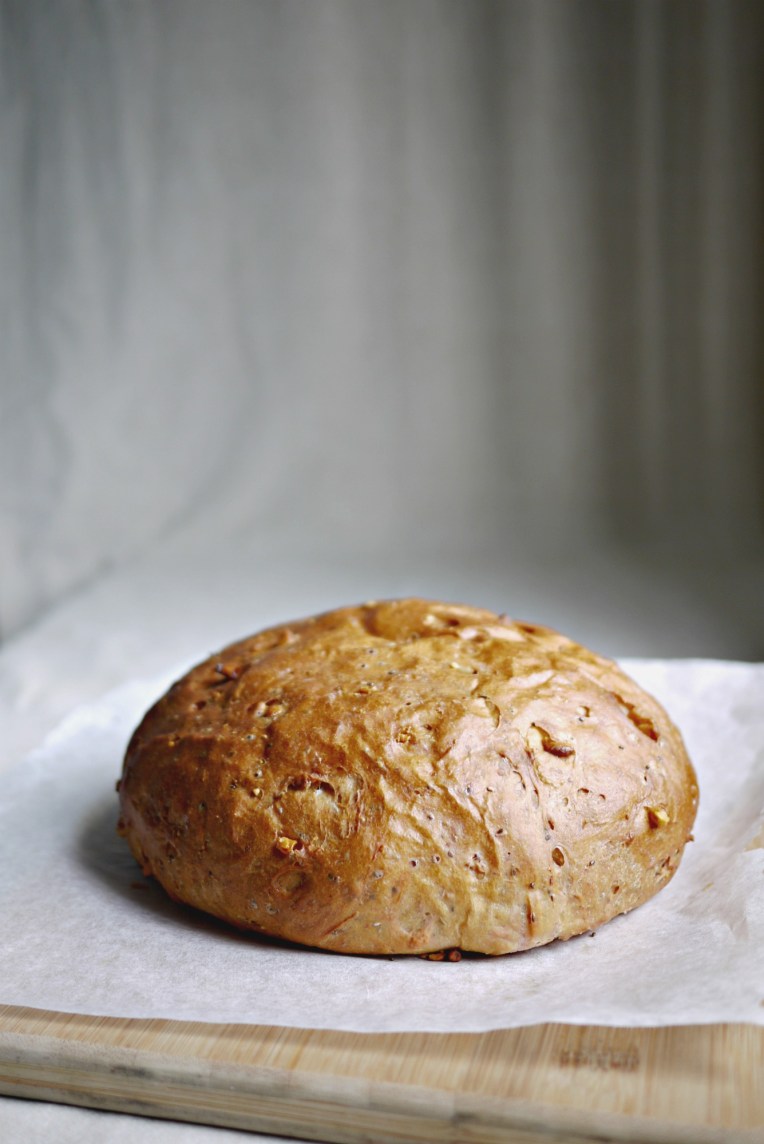
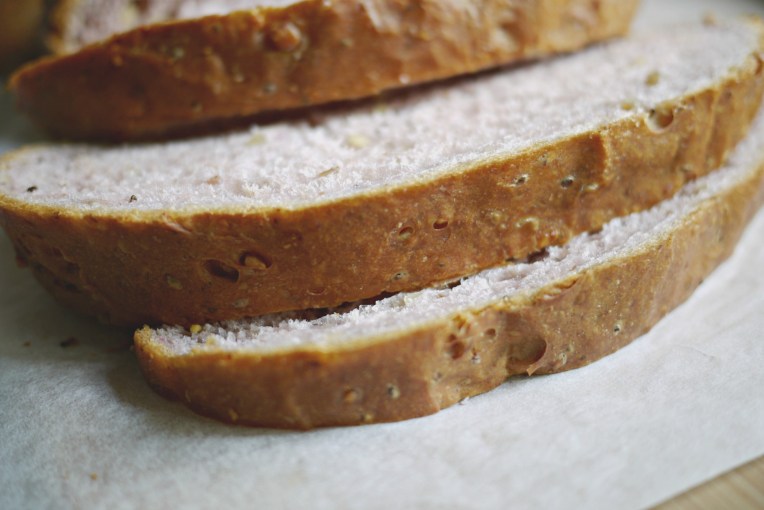
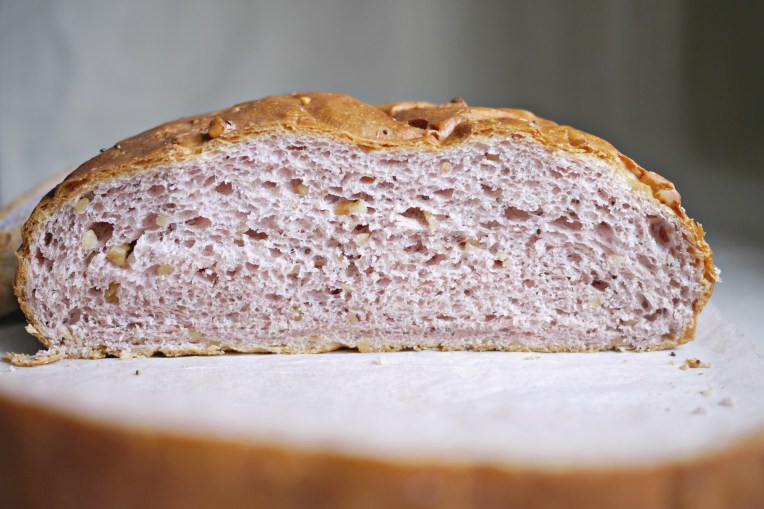
Walnut Chia Seed Sweet Potato Bread

Walnut Chia Seed Purple Sweet Potato Boule // Mono+Co

My solid wood counter top recently started to warp and I texted to ask my contractor, how can stone warp.  You see, I always thought I have a stone surface given its natural stone-like finishing, at least to my absolutely untrained eyes.  It’s not my contractor’s fault, as the kitchen wasn’t really a big a part of my life then when we first moved in.  I left the choice of layout and materials to them as it wasn’t exactly a favorite part of my house.  That’s how I ended up thinking I had a stone counter.

And more than 10 years later, I had the cheek to ask for a possible material defect check.  This mistake was so ridiculous, I started laughing at myself after ending the conversation.  Goes to show how little I know about renovations.  I am more of a touch-up fan than an overhaul person.  But this time, the damage is far too serious to be touched up, and a replacement looks inevitable.

Then I started imagining myself, excitedly, kneading bread on a marble top, or a beautiful butcher block counter. Basically, materials that are drop dead gorgeous but will require relatively higher maintenance and care, something I am not willing to spend too much time on.  I don’t even hand knead my bread to begin with!  So going back to reality, I will talk to my contractor about the more practical choices, and this time, you bet I will be much more informed and more involved.  This habit has finally come in handy.

Speaking of hand-knead loaves, boule is a favorite style that I like to associate 100% handmade bread with.  And this walnut chia seed potato bread is one that I would bake into a boule when I am not baking with a bread tin, even though I knead all the time with an electric mixer.

Walnut Chia Seed Purple Sweet Potato Boule // Mono+CoWalnut Chia Seed Purple Sweet Potato Boule // Mono+Co


Walnut Chia Seeds Potato Bread

200g bread flour
1/2 tablespoon instant dry yeast
1/4 teaspoon sea salt
2 tablespoons raw sugar
100g purple sweet potato, steamed+mashed
1 large egg **
30g water
35g cold unsalted butter, cubed
50g walnuts ***
3/4 tablespoon chia seeds

** I use large egg that weighs around 70g
*** Pulse walnuts in a food processor 3 or 4 times to break them up into medium size pieces.  Do not mill them into grounds or paste.

In a mixer bowl, add bread flour, instant yeast, sea salt, sugar, stir with a hand whisk to mix the dry ingredients together uniformly.

Add mashed sweet potatoes, beaten egg, and water, and knead them into a ball using a dough hook attachment with the mixer turned on to its lowest speed (KA 1).

Turn off the mixer and leave the ball dough to sit for 15 minutes.  Then restart the mixer and knead for 1 minute before adding the cubed butter one by one with the mixer running.

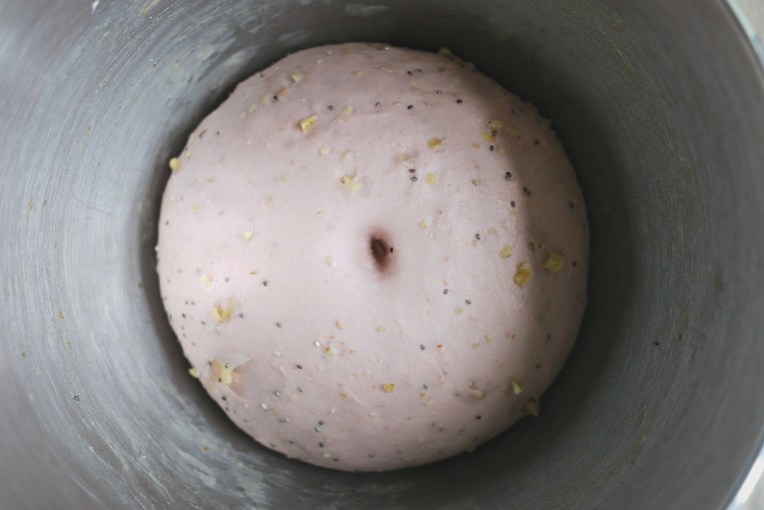
Keep kneading until there are no traces of butter left, and the dough reaches window pane stage and becomes very elastic.  Add walnuts and chia seeds, and mix them uniformly into the dough. Leave this aside to bulk rise for 60 minutes.

The dough will double its volume and is ready for shaping if you can do this “belly button test”, the dent made with a floured finger doesn’t bounce back.
Walnut Chia Seed Purple Sweet Potato Boule // Mono+Co

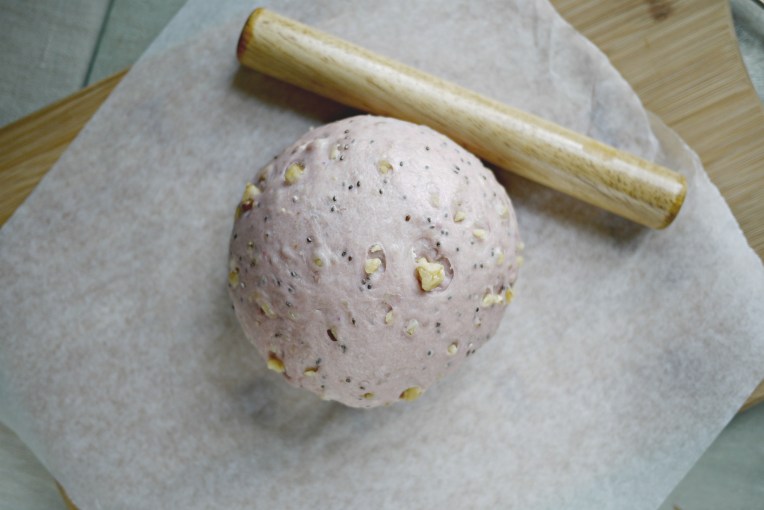
Punch to deflate the dough, and transfer it to a clean work top.  Flatten the dough with hands to push out trapped gas.  Usually, I use a rolling pin for this purpose, but this would be difficult with pieces of walnuts in the dough.  I place it in the photos to show the difference in the size of the dough before and after the final proof.

Shape the dough into a ball, and place it on a greased/lined baking tray, mine measures 30cm x 30cm.  Leave this covered, in a draft-free place.  I put mine in the oven, without the power turned on.

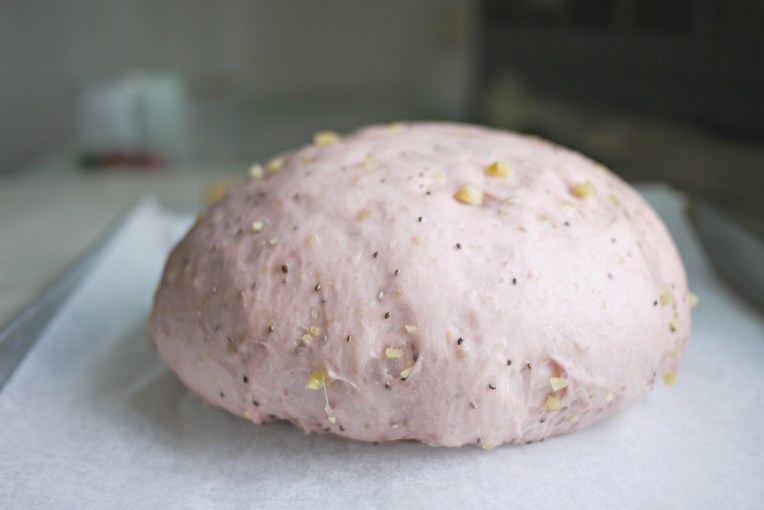
Walnut Chia Seed Purple Sweet Potato Boule // Mono+CoWalnut Chia Seed Purple Sweet Potato Boule // Mono+Co

This is the dough after 60 minutes of final proof.

Walnut Chia Seed Purple Sweet Potato Boule // Mono+Co

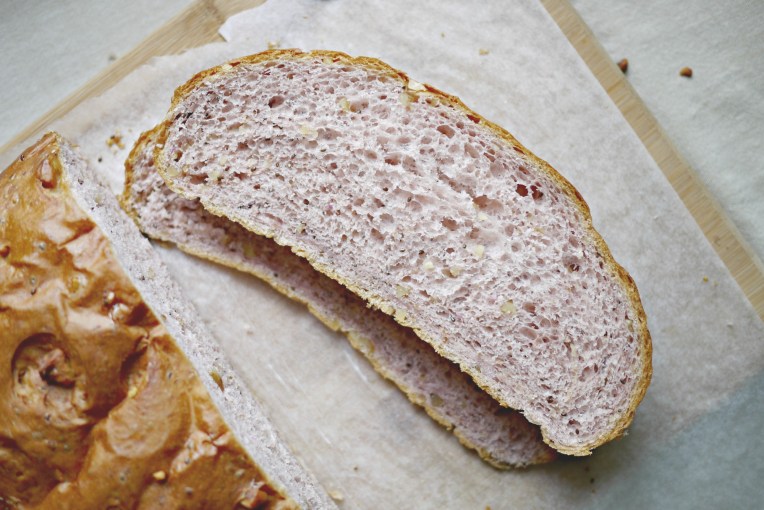
Bake it in a preheat oven 170C for 22-25 minutes, until it turns golden brown.  Then leave it to cool completely on a rack before slicing.

Enjoy.

Walnut Chia Seed Purple Sweet Potato Boule // Mono+Co Walnut Chia Seed Purple Sweet Potato Boule // Mono+Co

Save

Save

Save

Save

Save

Save

Save

Save

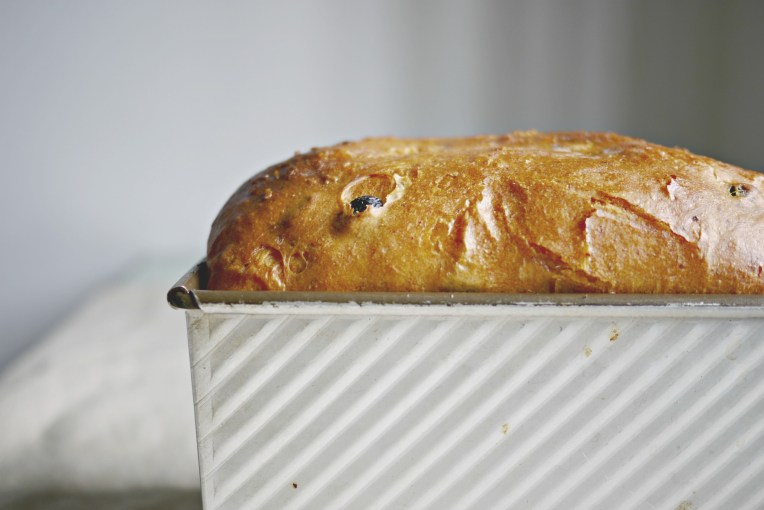
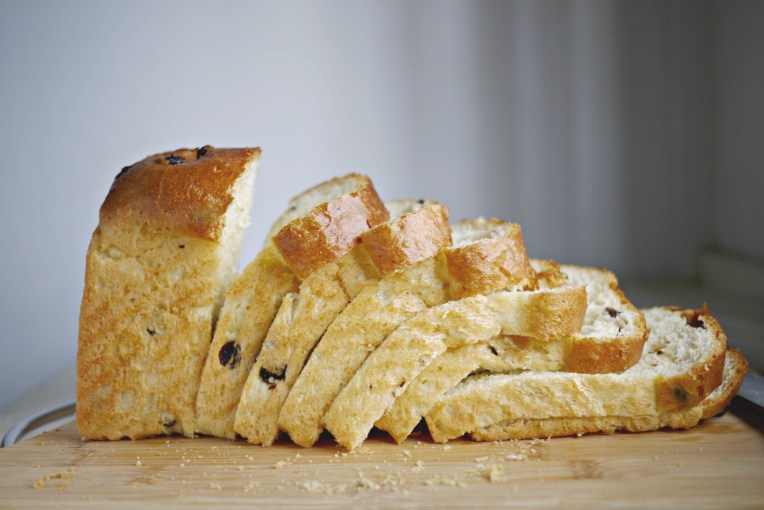
Raisin Potato Bread Loaf

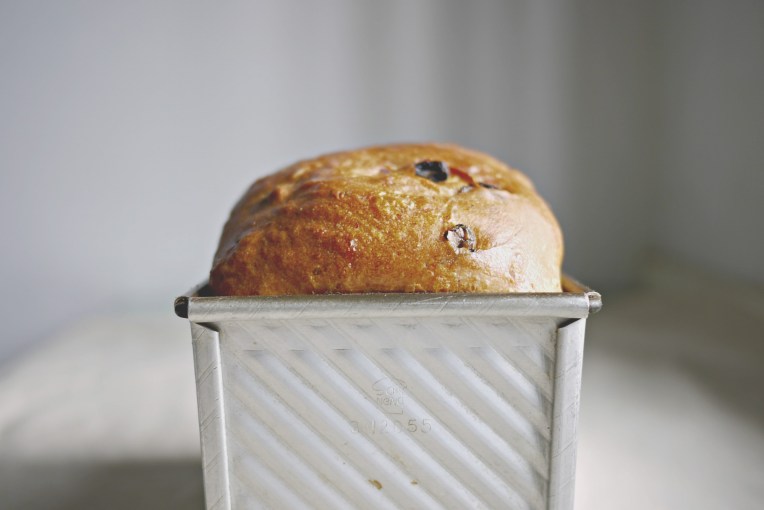
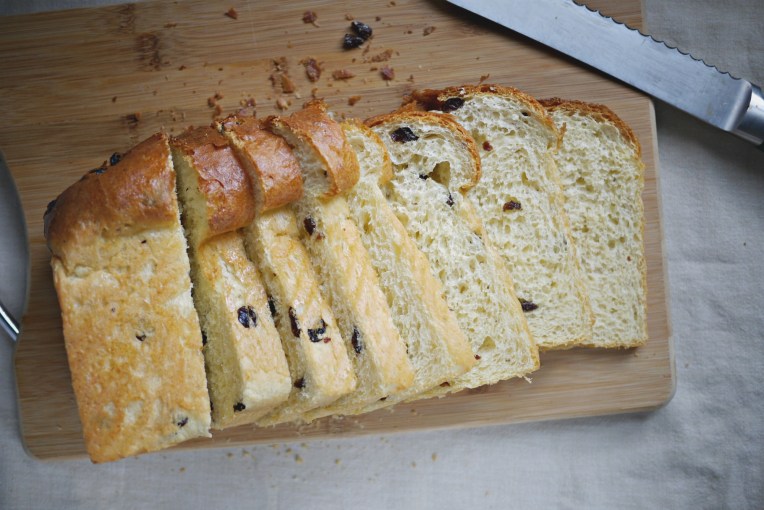
Raisin Potato Bread Loaf // Mono+Co Raisin Potato Bread Loaf // Mono+Co

Raisins in bread are always welcome.  The addition of potato made the loaf really soft, as I was slicing it, every piece bended and collapsed beautifully on the one before.

This loaf got wiped out in one day.  Time to get on with ideas for the next potato bread.  I think I just saw purple sweet potatoes at the kitchen counter.

Raisin Potato Bread Loaf // Mono+Co Raisin Potato Bread Loaf // Mono+CoRaisin Potato Bread Loaf // Mono+Co  Raisin Potato Bread Loaf // Mono+Co


Raisin Potato Bread Loaf

220g plain flour
1/2 tablespoon instant dry yeast
1/4 teaspoon sea salt
2 tablespoon raw sugar
100g mashed potato
1 large egg, beaten **
30-40g potato water ***
35g cold butter, cubed
60g raisins ****

** I used a large egg that weighs 70grams with shell.

*** Potato water refers to the water that the potatoes were cooked in.  Cool it down to room temperature before using.

**** Up to 100g of raisins if you really like lots of raisins in your bread.

In a bowl, add the raisins and pour just enough warm water to cover the raisins.  This helps to hydrate them and prevent the raisins from drawing moisture from the bread when they are mixed into the dough.

In a mixer bowl, combine plain flour, instant yeast, raw sugar, sea salt with a hand whisk to form a uniform mixture of dry ingredients.  Add mashed potato, egg, and water next.  Turn on the mixer with a dough hook attachment and knead these ingredients on the lowest speed (KA 1) till they come into a ball.  Continue to knead for 3 minutes, then stop the mixer and let the dough sit for 15 minutes.

Turn on the mixer again and knead for 1 minute before adding butter cubes one by one while the mixer is running on its lowest speed.  Keep kneading till there are no traces of butter left and the dough has reached window pane stage.  At this stage, the dough will be extremely pliable and baby-bottom soft.  Stop the mixer for a while.

With one hand, squeeze to dry the raisins that have been soaked in warm water.  Add them to the dough in the mixer bowl, and start the mixer again on its lowest speed to incorporate the raisins into the dough.  Frankly, the electric mixer won’t do a very good job at mixing the raisins uniformly into the dough without over-kneading it.  I usually stop the mixer after 1-2 minute and take over to knead by hand, trying my best to spread the raisins  and make sure that they don’t clump at one spot.  This is to ensure that there will be raisins on every slice of the bread.

Leave the dough in the mixer bowl for its first proof of 60 minutes.  The dough will rise to double its volume,  punch down to deflate and transfer it to a clean worktop.

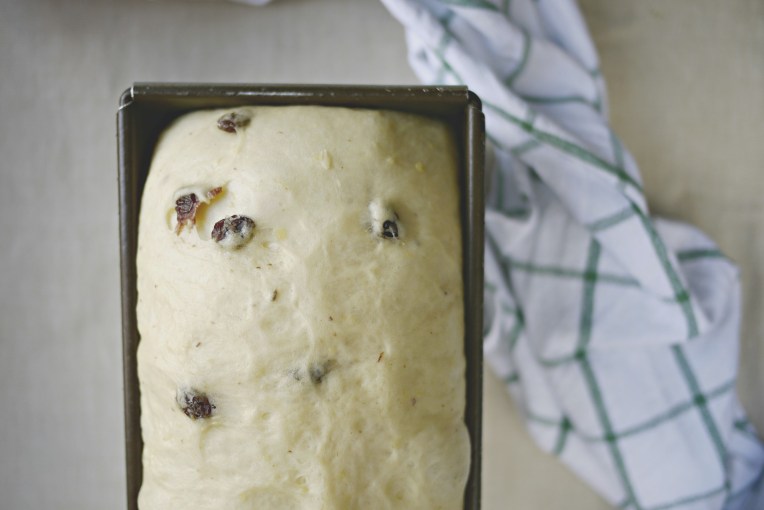
Flatten the dough with rolling-pin to push out any gas trapped inside the dough during proofing.  Shape the dough and place in a bread tin.  Proof for 50-60 minutes.

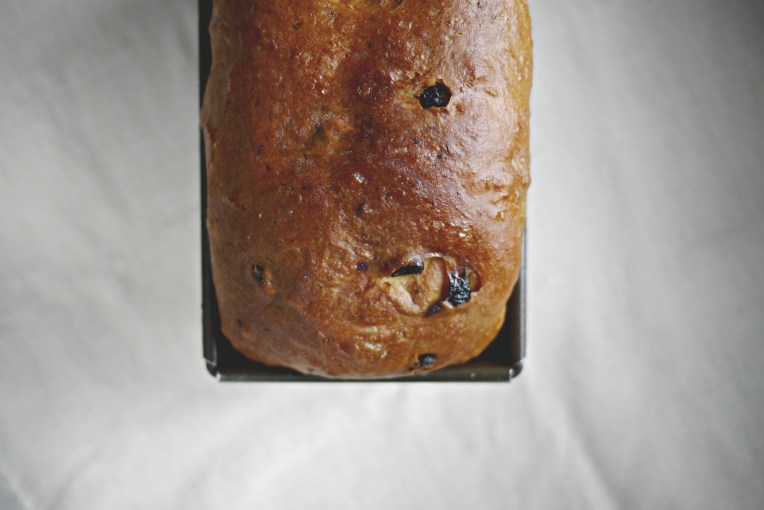
Bake in a preheated oven at 170C for 30 minutes.  Remove bread from bread tin immediately after baking and let it cool completely on a rack before slicing.

To soften the top crust, brush melted butter over the top of the loaf while it is hot.  I keep a handy small block of butter just for this purpose and run it over the crust and let the heat from the bread melt the butter as they come in contact.  Save the hassle of melting butter and washing an oily brush.

Save

Save

Save

Save

Save

Save

Save

Save

Charcoal Potato Dried Cheese Buns

Charcoal Potato Grated Cheese Buns // Mono+Co Charcoal Potato Grated Cheese Buns // Mono+Co

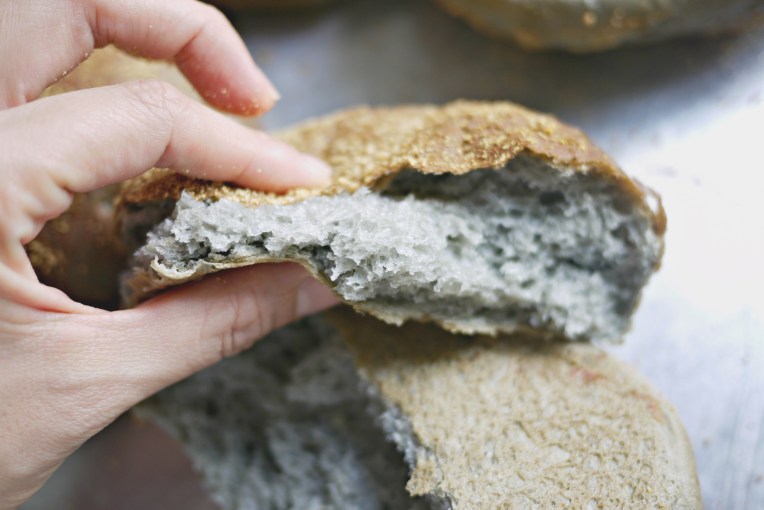
For my family, buns get consumed faster than sliced bread loaf, whether store-bought or homemade.  So it makes a lot of sense to be baking bamboo charcoal buns since I am trying to finish a bottle of the charcoal powder by year end.  I fiddled around with the usual potato bread recipe by adding more fats and reducing mashed potato amount to 100g.  The end result : 4 huge and fluffy buns.

I coated the dough with dried grated cheese, got them with my pasta/ pizza takeaways.  If you have them in your pantry, add them, if not, omit them.  Personally, I do not purchase these powdered cheese as they taste more like salty MSG flavoring than cheese.  You bet I will be making these buns with real cheese topping very soon.

Charcoal Potato Grated Cheese Buns // Mono+Co Charcoal Potato Grated Cheese Buns // Mono+Co Charcoal Potato Grated Cheese Buns // Mono+Co


Charcoal Potato Dried Cheese Buns

220g plain flour
1/2 tablespoon instant dry yeast
1/4 teaspoon sea salt
1/4 teaspoon bamboo charcoal powder
2 tablespoons raw sugar
100g mashed potato
1 large egg **
40g potato water ***
40g cold butter, cubed
20g dried grated cheese, optional

** I used an egg that weighs 70g with shell.

*** Potato water refers to the water that is left behind after cooking the potatoes with.  Cool it down to room temperature before adding them to the rest of the ingredients.

In a mixer bowl, combine plain flour, instant yeast, sea salt, bamboo charcoal powder, raw sugar with a hand whisk to stir the dry ingredients into a uniform mixture.

Add mashed potato, beaten egg, and potato water.  Turn on the electric mixer and knead the ingredients on the lowest speed (KA 1) until they come into a ball.  Continue to knead for about 3 minutes and then turn off the mixer and let this dough stand for 15 minutes.

Turn on the mixer to knead the dough for 1 minute, before adding cubed butter, one by one, while the mixer is running.  Continue to knead even after no traces of butter can be seen, until the dough reach window pane stage, this is when the dough becomes super stretchy and soft, though slightly sticky.  You can tell that you have reached this stage when the dough looks being lifted completely from the bottom and pulling itself away cleanly from the side of the mixing bowl, leaving no messy traces of dough behind.  At this stage, stop the mixer and leave the dough to rise in the covered mixer bowl for 60 minutes.

The dough should rise to double its volume.  Punch down the dough to deflate it and transfer it to a clean work top.  The dough will be sticky, dust hands and worktop with a little flour.  Divide the dough into 4 equal portions.  Flatten each dough to push out any gas trapped inside the dough, shape them into balls.  Holding the seam side of the ball dough, dip it into a small plate filled with grated cheese to coat the top side of the bread with the cheese before arranging it on a greased baking pan, seam side downwards.  Repeat until all 4 doughs are shaped and leave the pan in a draft-free place, covered with a clean towel, to have a final proof of 50 minutes.

Bake the buns in a preheat oven at 170C for 20-25 minutes.  Remove them from the pan and leave to cool completely.

220Save

Save

Save

Purple Sweet Potato Bread Loaf #2

Purple Sweet Potato Bread Loaf // Mono+CoPurple Sweet Potato Bread Loaf // Mono+Co

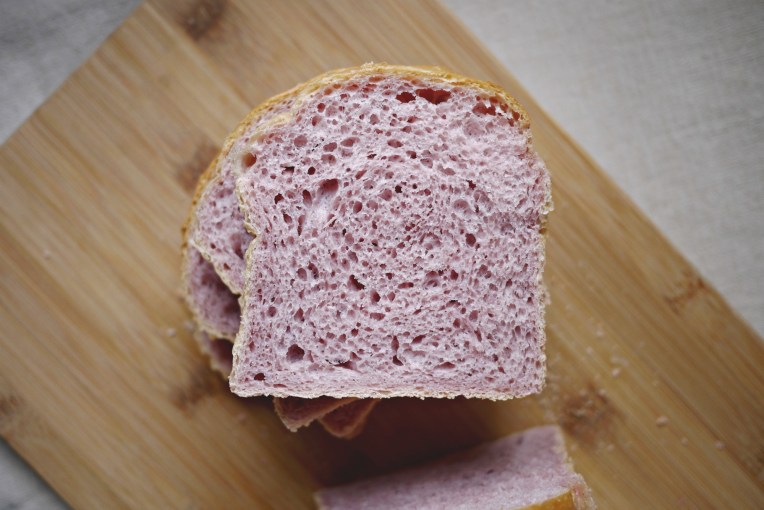
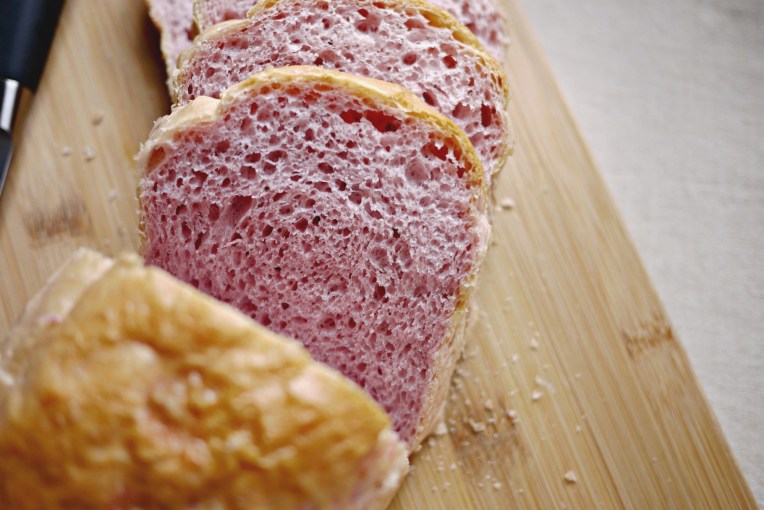
The purple sweet potato bread I baked last week was not purple enough, so I baked another version using my usual mashed potatoes recipe.  Actually the earlier version got its color from only 30 grams of sweet potatoes and 20 grams of water that I boiled the potatoes in.  This time, I made the color more intense by using 100grams of potatoes, steaming it instead of boiling to cook it.

Thinking that the sweet potatoes will be sweet enough to replace the sugar, I omitted any sweeteners, and ended up with a really bland but still pillowy loaf.  Not that I mind, traditional bread recipes do not add sugar anyway.  The bread was meant to be eaten with butter and spreads, so it did not really bother me, though I did wonder if the bread would have risen higher if sugar was added, given that it was a 220g of flour recipe.  I have baked taller loaves.

I will find out when I bake this again if I see purple sweet potatoes available in the market next week.
Purple Sweet Potato Bread Loaf // Mono+Co   Purple Sweet Potato Bread Loaf // Mono+Co Purple Sweet Potato Bread Loaf // Mono+Co  Purple Sweet Potato Bread Loaf // Mono+CoPurple Sweet Potato Bread Loaf // Mono+Co Purple Sweet Potato Bread Loaf // Mono+Co


Purple Sweet Potato Bread Loaf

220g plain flour
1/2 tablespoon instant yeast
1/4 teaspoon sea salt
100g mashed purple sweet potatoes
1/2 egg
40g water
30g cold unsalted butter, cubed

Combine flour, yeast and salt in a mixer bowl and stir with hand whisk to mix them well.  Add sweet potatoes, beaten egg and water, turn the mixer on lowest speed (KA1) with a dough hook, and knead till the ingredients come into a ball.  Stop the mixer and let this dough stand for 15 minutes to allow liquid to be absorbed better by the flour, I find that kneading to reach window pane stage later will be easier with this additional dough resting step.

After 15 minutes, turn the mixer on again to knead the dough for 1 minute, then slowly add cubed butter one by one, and knead till dough reaches window pane stage.  Remove bowl from mixer, and let it proof for 60 minutes, covered and placed in a draft free place.

The dough would have expanded to twice its size, punch down the dough to deflate it, and transfer it to a clean work top.  With a rolling pin, flatten the dough to push out gases trapped inside the dough.  Shape the dough and place in bread tin, seam side downwards, and proof for another 60 minutes.

Bake in a preheated oven at 170C for 30 minutes.  When done, remove bread from tin immediately and let it cool completely on a cooling rack before slicing.

If you like bread loaf soft at the top, brush over the top crust with butter when the bread is freshly hot out of the oven.  The soft dome top also makes slicing the bread easier after it has cooled down.

In Save

Save

Meatfree Pumpkin Stuffed Rice

Meatfree Pumpkin Stuffed Rice // Mono+Co

Whenever I feel like preparing a healthy meal, the quickest fix is to replace white rice with a whole grain mix.  I keep a bag of 5 grains mix at home that consists of brown rice, oat, barley, buckwheat, and sorghum, a really convenient pantry item to have around when I want some vitamin-packed, fibre-enriched wholesome goodness.   Stir fry the cooked grains with chopped garlic, brown mushrooms, and red capsicum to make a quick and simple one-dish meal.   Or turn it into a really presentable one by stuffing the grains into a pumpkin, steamed for 20 minutes, and then serve it piping hot.

I cook the grains with tomatoes and sometimes pumpkin slices, so that after the grains are cooked, I stir to mix softened tomatoes and pumpkin flesh into the rice, and this is already good enough to be eaten on its own.  The ingredients are so rich in flavor that I only need to season with black pepper.  The sweetness from pumpkins, tomatoes, the umami from mushrooms, even the nutty grains are indeed good enough on their own for me to taste delicious in every bite.  But I have a very high tolerance for under-seasoned food, so go ahead and sprinkle some sea salt if you find it tasting “flat”.

Cooking the mixed grains takes up quite some time if you are in a hurry.  A great time-saving suggestion.  Make them ahead and store them in handy serving sizes in the freezer.  I cook up to 4 cups of the mix grains, then divide them into 4 portions to be kept in the freezer up to 1 month, this handy size of 1 cup per portion makes it super convenient for me to have ready-cooked grains anytime, whether I want to make a meal for 1 or 2 or 4.


Meatfree Pumpkin Stuffed Rice

1 cup uncooked 5-grains mix
1 & 1/4 cup water
8-10 cherry tomatoes
200g brown button mushrooms, sliced
1/4 red capsicum, diced**
1 clove garlic, minced
2 whole small pumpkins
1 tablespoon light olive oil
ground black pepper, sea salt, to taste

**  For this small serving recipe, I use only the red version.  If making a large serving, you might want to add more colors by adding the yellow and green capsicums.

Place 1 cup of 5 grains mix (rinsed and drained), water, cherry tomatoes, a dash of pepper in a covered pot, and cooked till all the water has evaporated.  Turn off the heat and leave this to stand for at least 10 minutes.  Uncover the pot, and stir to mix the cooked tomatoes with the grains using a wooden spoon.  Leave the pot uncovered to rid excess moisture and for rice to cool down.

Meatfree Pumpkin Stuffed Rice // Mono+Co

When the rice is cooling down, prep the pumpkins by cutting out the tops with a sharp knife to make lids.  Scoop out the seeds with a small metal spoon, creating a hollow center for stuffing the grains with later.

Meatfree Pumpkin Stuffed Rice // Mono+Co Meatfree Pumpkin Stuffed Rice // Mono+Co

Now we are ready to stir fry the mix grains.  In a heated pan, add olive oil and fry minced garlic till aromatic.  Add in diced capsicum and sliced brown mushrooms, cook till the mushrooms start to sweat.  add in the cooked grains, and stir around to mix the ingredients well.  Season with sea salt and black pepper to taste.  Remove pan from heat.

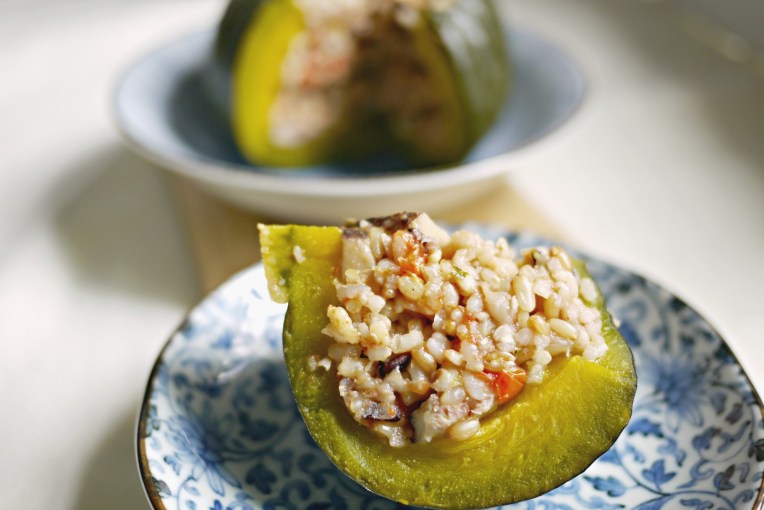
Stuff the pumpkins with cooked grains and cover with the cut-out lids, steam for 20 minutes on high heat.  The pumpkins are cooked when you can insert a skewer easily.  Remove from steamer and transfer them on a serving plate.  To keep the grains warm, do not cut the pumpkins until you are ready to eat.  Depending on what else you are serving these with, you can serve them in wedges, or halves.

Meatfree Pumpkin Stuffed Rice // Mono+Co

Meatfree Pumpkin Stuffed Rice // Mono+Co

Save

Save

Save

Save

Save

Save

Save

Save

Save

Bamboo Charcoal Potato Bread Loaf

Bamboo Charcoal Potato Bread Loaf // Mono+Co Bamboo Charcoal Potato Bread Loaf // Mono+Co

The bread recipe with root vegetable as an additive is so versatile that I continue to experiment with additional ingredients like dry fruits or nuts.  They all come out great, soft and fluffy.  But sometimes, it is nice to go back to basic plain potato bread.

I added the bamboo charcoal powder to the regular recipe because I realise that it is expiring in 4 months.  I need to make a lot more charcoal bread this month to use up the bottle.  Who knew a 40-gram bottle could last so long?

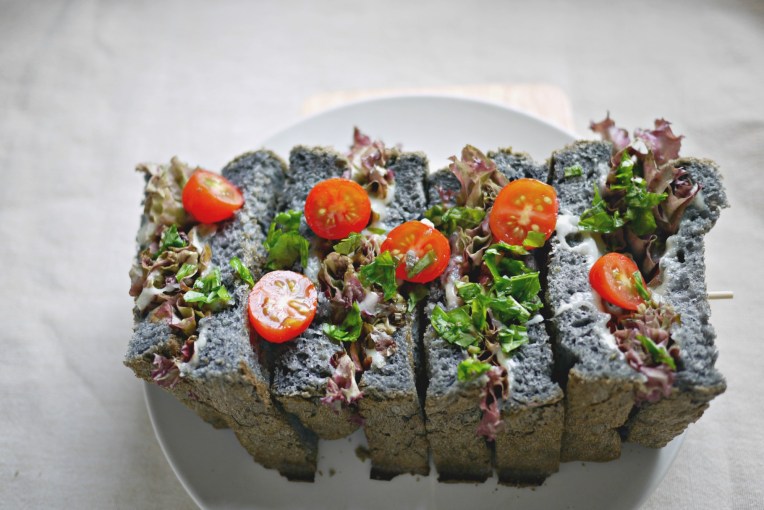
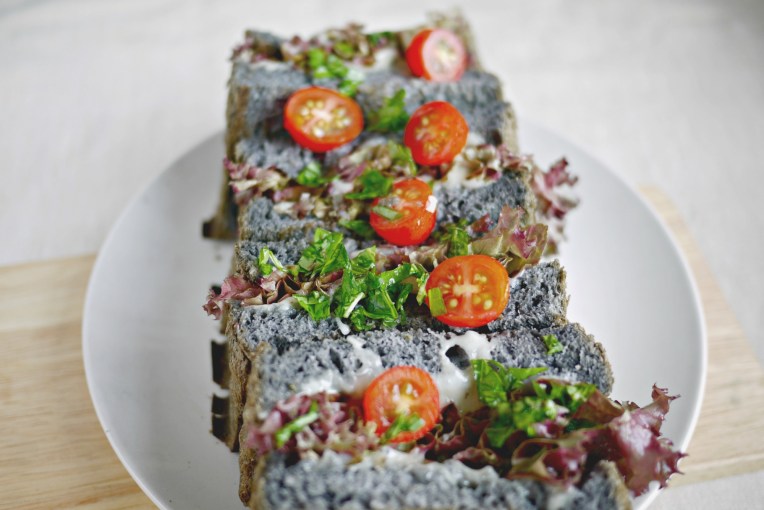
The charcoal powder imparts no flavourings at all to the bread.  So if one eats it with eyes closed, he won’t be able to tell it apart from plain white bread.  But I eat with my eyes wide open, so I turn these black bread slices into a pretty sandwich by teaming them with grilled vegetarian cheese, red lettuce, sweet basil and cherry tomatoes.

With all these vibrant colors from the ingredients, definitely a feast for my eyes.

Bamboo Charcoal Potato Bread Loaf // Mono+Co

Bamboo Charcoal Potato Bread Loaf // Mono+Co


Basic Bamboo Charcoal Potato Bread Loaf

220g plain flour
1/2 tablespoon edible charcoal powder
1/2 tablespoon instant dry yeast
1/4 teaspoon sea salt
2 tablespoons raw sugar
125g mashed potatoes
40g potato water **
1/2 egg ***
30g cold unsalted butter,cubed

** Potato water refers to the water that is left behind after cooking the potatoes with.  Cool it down to room temperature before using.

*** I use large eggs that weigh above 70g with shell, if you have smaller eggs, simply weigh out 35g for this recipe.

In a mixer bowl, stir plain flour, charcoal powder, yeast, sea salt, raw sugar with a hand whisk to mix these dry ingredients uniformly.  Next, add mashed potatoes, potato water, and egg, then knead using an electric mixer with dough hook on the lowest speed (KA 1) until the ingredients come into a ball.  Continue to knead this for about 3 minutes, then stop the mixer and leave this dough to stand for 15 minutes.

Turn on the mixer again on its lowest speed and knead the dough for another 1 minute.  After that, add butter cubes one by one carefully with the mixer running, keep kneading until no visible traces of butter can be seen in the bowl and the dough has reached window pane stage.  The dough should be extremely soft and pliable now, stop the mixer and leave the dough in the bowl, covered.  Proof this for 60 minutes.

The dough will double in volume after its first proof.  Punch down to deflate it and transfer to a clean work top.  Dust hands and worktop with a little flour if the dough is too sticky to handle.  Flatten dough either with palms or rolling pin to push out any gases trapped inside the dough.  Shape the dough and place it in the bread tin, seam side downwards.

If making a square loaf, check on the dough 50 minutes after proofing, the dough should rise to cover about 90% of the height of the tin.  Slide over the cover to enclose the bread and continue to proof for another 10 minutes before baking.  Bake the bread covered in a preheated oven at 200C for 30 minutes.

If making a dome-shaped bread loaf, proof it for 60 minutes.  If the dough has risen above the bread tin, proceed to bake.  If not, give it another 10-15 minutes to rise.  However, do not extend the proof time further than 90minutes, as this will run the risk of over-proofing the dough.  Bake in a preheated oven at 170C for 30 minutes.

Remove bread from tin immediately after baking and leave it to cool completely on a rack before slicing.

Save

Save

Save

Save

Save

Save